


Page 313 - Mathematical Models and Algorithms for Power System Optimization
P. 313
Local Decoupling Control Method for Transient Stability of a Power System 305
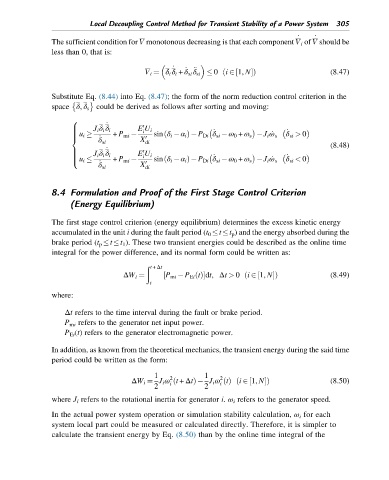
The sufficient condition for V monotonous decreasing is that each component V i of V should be
less than 0, that is:
_ _ €
V i ¼ δ i δ i + δ si δ si 0 i 2 1, N½ð Þ (8.47)
Substitute Eq. (8.44) into Eq. (8.47); the form of the norm reduction control criterion in the
space δ, δ s could be derived as follows after sorting and moving:
_
8
J i δ i δ i E U i
> 0
> i _ _
> u i + P mi ð δ si > 0
> sin δ i α i Þ P Di δ si ω 0 + ω s J i _ ω s
< _ X 0
δ si di (8.48)
_
> 0
> J i δ i δ i E U i
> i _ _
ð
> u i + P mi sin δ i α i Þ P Di δ si ω 0 + ω s J i _ ω s δ si < 0
: _ X 0
δ si di
8.4 Formulation and Proof of the First Stage Control Criterion
(Energy Equilibrium)
The first stage control criterion (energy equilibrium) determines the excess kinetic energy
accumulated in the unit i during the fault period (t 0 t t p ) and the energy absorbed during the
brake period (t p t t 1 ). These two transient energies could be described as the online time
integral for the power difference, and its normal form could be written as:
ð t + Δt
ΔW i ¼ ½ P mi P Ei tðÞdt, Δt > 0 i 2 1, NÞ (8.49)
½
ð
t
where:
Δt refers to the time interval during the fault or brake period.
P mi refers to the generator net input power.
P Ei (t) refers to the generator electromagnetic power.
In addition, as known from the theoretical mechanics, the transient energy during the said time
period could be written as the form:
1 2 1 2
ð
ΔW i ¼ J i ω t + ΔtÞ J i ω t ðÞ i 2 1, Nð ½ Þ (8.50)
i
i
2 2
where J i refers to the rotational inertia for generator i. ω i refers to the generator speed.
In the actual power system operation or simulation stability calculation, ω i for each
system local part could be measured or calculated directly. Therefore, it is simpler to
calculate the transient energy by Eq. (8.50) than by the online time integral of the

