


Page 310 - Mathematical Models and Algorithms for Power System Optimization
P. 310
302 Chapter 8
8.3.3.5 Formulation of norm reduction control criterion
The origin of observation decoupled state space is the steady equilibrium point of the system. If
n _ o
the maximum deviation of the observation decoupled state variable δ i , δ i of the system after
the fault is monotonously decreasing with the time t against the origin {0, 0}, then the system
will finally return to the steady equilibrium state.
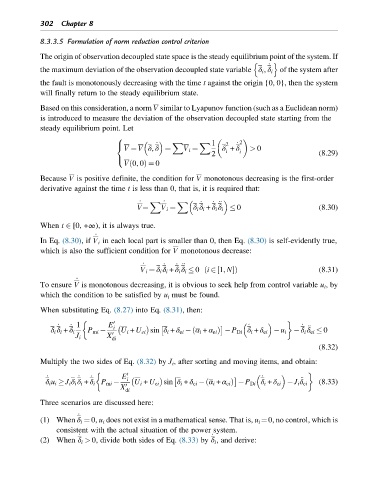
Based on this consideration, a norm V similar to Lyapunov function (such as a Euclidean norm)
is introduced to measure the deviation of the observation decoupled state starting from the
steady equilibrium point. Let
8
X X 1 2
2
< _ δ + δ _
V ¼ V δ, δ ¼ V i ¼ i i > 0
2 (8.29)
:
V 0, 0Þ ¼ 0
ð
Because V is positive definite, the condition for V monotonous decreasing is the first-order
derivative against the time t is less than 0, that is, it is required that:
X
X _ _ €
V¼ V i ¼ δ i δ i + δ i δ i 0 (8.30)
When t 2 [0, +∞), it is always true.
In Eq. (8.30),if V i in each local part is smaller than 0, then Eq. (8.30) is self-evidently true,
which is also the sufficient condition for V monotonous decrease:
_ _ €
½
ð
V i ¼ δ i δ i + δ i δ i 0 i 2 1, NÞ (8.31)
To ensure V is monotonous decreasing, it is obvious to seek help from control variable u i ,by
which the condition to be satisfied by u i must be found.
When substituting Eq. (8.27) into Eq. (8.31), then:
0
_ _ 1 E _ _ €
i
ð
δ i δ i + δ i P mi 0 U i + U ei sin δ i + δ ei α i + α ei Þ P Di δ i + δ ei u i δ i δ ei 0
J i X
di
(8.32)
Multiply the two sides of Eq. (8.32) by J i , after sorting and moving items, and obtain:
0
_ _ _ E _ €
i
ð
δ i u i J i δ i δ i + δ i P mi U i + U ei sin δ i + δ ei α i + α ei Þ P Di δ i + δ ei J i δ ei (8.33)
X 0
di
Three scenarios are discussed here:
_
(1) When δ i ¼ 0, u i does not exist in a mathematical sense. That is, u i ¼0, no control, which is
consistent with the actual situation of the power system.
_ _
(2) When δ i > 0, divide both sides of Eq. (8.33) by δ i , and derive:

