


Page 300 - Mathematical Models and Algorithms for Power System Optimization
P. 300
292 Chapter 8

            8.3.2 Basic Concept of the First Stage Control Criterion (Energy Equilibrium)

            The major theoretical foundation for the first stage (energy equilibrium) control is an equal area
            criterion.
            The equal area criterion generally applies to the analysis of a simple single-machine infinite-
            bus system only; however, in the initial stage of fault at part i of the system, the rest of the
            system has not had severe swing yet, and the inertia constant T Ji of part i of the system is far less
                        X                                                 X
            than the sum   T Jj of the inertia constants of other parts, that is, T Ji ≪  T Jj . So in the initial
                        j6¼i                                               j6¼i
            stage of the fault, that is, the first stage energy equilibrium control stage, the relation of the
            faulty part of system to the rest of the system could be temporarily taken as a simple
            relation with a single-machine infinite-bus system. Therefore, as for the energy equilibrium
            control in the first stage, the equal area criterion can be used for dynamic analysis for the
            faulty part i of the system.
            It is known from the equal area criterion that, when the maximum possible deceleration area is
            less than the acceleration area, the system is in transient stability state, and the purpose
            of the electric braking in the initial period of the fault is to heighten the power angle
            characteristic curve and enlarge the deceleration area, so as to decrease the power angle swing
            and avoid loss of synchronism in the first swing period. The optimal switch-off time for the
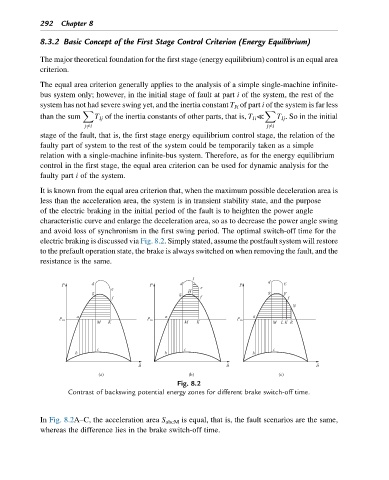
            electric braking is discussed via Fig. 8.2. Simply stated, assume the postfault system will restore
            to the prefault operation state, the brake is always switched on when removing the fault, and the
            resistance is the same.


                                                  Fig. 8.2
                    Contrast of backswing potential energy zones for different brake switch-off time.


            In Fig. 8.2A–C, the acceleration area S abcM is equal, that is, the fault scenarios are the same,
            whereas the difference lies in the brake switch-off time.

