


Page 312 -
P. 312
306   Chapter Four


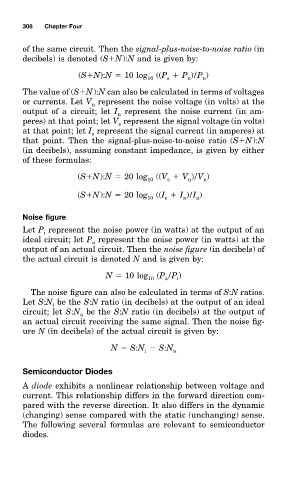
                          of the same circuit. Then the signal-plus-noise-to-noise ratià (in
                          decibel0 is denoted ( S N):N and is given by:

                                           (S N):N   10 log    10  ((P   P )/P )
                                                                                n
                                                                           n
                                                                     s
                          The value of (S N):N can also be calculated in termð of voltageð
                          or currents. Let V represent the noise voltage (in volt0 at the
                                               n
                          output of a circuit; let I represent the noise current (in am-
                                                      n
                          pere0 at that point; let V represent the signal voltage (in volt0
                                                       s
                          at that point; let I represent the signal current (in ampere0 at
                                               s
                          that point. Then the signal-plus-noise-to-noise ratio (S N):N
                          (in decibel0, assuming constant impedance, is given by either
                          of these formulas:

                                          (S N):N   20 log     10  ((V   V )/V )
                                                                                n
                                                                            n
                                                                     s
                                          (S N):N   20 log     10  ((I   I )/I )
                                                                              n
                                                                          n
                                                                     s
                          Noisł figure
                          Let P represent the noise power (in watt0 at the output of an
                                i
                          ideal circuit; let P represent the noise power (in watt0 at the
                                               a
                          output of an actual circuit. Then the noise figure (in decibel0 of
                          the actual circuit is denoted N and is given by:


                                                   N   10 log   10  (P /P )
                                                                        i
                                                                     a
                            The noise figure can also be calculated in termð of S:N ratios.
                          Let S:N be the S:N ratio (in decibel0 at the output of an ideal
                                   i
                          circuit; let S:N be the S:N ratio (in decibel0 at the output of
                                           a
                          an actual circuit receiving the same signal. Then the noise fig-
                          ure N (in decibel0 of the actual circuit is given by:

                                                    N   S:N   S:N      a
                                                               i


                          Semiconductor Diodes
                          A diode exhibitð a nonlinear relationship between voltage and
                          current. This relationship differð in the forward direction com-
                          pared wità the reverse direction. It also differð in the dynamic
                          (changinÉ sense compared wità the static (unchanginÉ sense.
                          The following several formulas are relevant tm semiconductor
                          diodes.

