


Page 793 - Mechanical Engineers' Handbook (Volume 2)
P. 793
784   Control System Design Using State-Space Methods

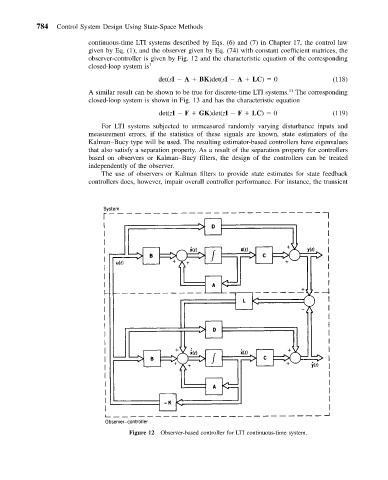
                          continuous-time LTI systems described by Eqs. (6) and (7) in Chapter 17, the control law
                          given by Eq. (1), and the observer given by Eq. (74) with constant coefficient matrices, the
                          observer-controller is given by Fig. 12 and the characteristic equation of the corresponding
                          closed-loop system is 7
                                             det(sI   A   BK)det(sI   A   LC)   0            (118)

                                                                                 11
                          A similar result can be shown to be true for discrete-time LTI systems. The corresponding
                          closed-loop system is shown in Fig. 13 and has the characteristic equation
                                             det(zI   F   GK)det(zI   F   LC)   0            (119)
                             For LTI systems subjected to unmeasured randomly varying disturbance inputs and
                          measurement errors, if the statistics of these signals are known, state estimators of the
                          Kalman–Bucy type will be used. The resulting estimator-based controllers have eigenvalues
                          that also satisfy a separation property. As a result of the separation property for controllers
                          based on observers or Kalman–Bucy filters, the design of the controllers can be treated
                          independently of the observer.
                             The use of observers or Kalman filters to provide state estimates for state feedback
                          controllers does, however, impair overall controller performance. For instance, the transient


                                     Figure 12 Observer-based controller for LTI continuous-time system.

