


Page 119 - Singiresu S. Rao-Mechanical Vibrations in SI Units, Global Edition-Pearson (2017)
P. 119
116    Chapter 1   Fundamentals oF Vibration
                                    problems


                                   section 1.4 basic Concepts of Vibration and
                                   section 1.6 Vibration analysis procedure
                                     1.1*  A study of the response of a human body subjected to vibration/shock is important in many
                                         applications. In a standing posture, the masses of head, upper torso, hips, and legs and
                                         the elasticity/damping of neck, spinal column, abdomen, and legs influence the response
                                           characteristics. Develop a sequence of three improved approximations for modeling the
                                         human body.

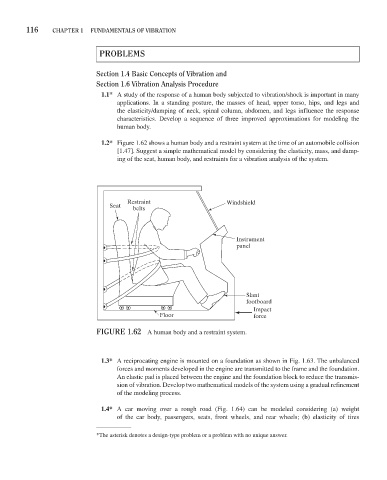
                                     1.2*  Figure 1.62 shows a human body and a restraint system at the time of an automobile collision
                                         [1.47]. Suggest a simple mathematical model by considering the elasticity, mass, and damp-
                                         ing of the seat, human body, and restraints for a vibration analysis of the system.


                                            Restraint                  Windshield
                                       Seat  belts


                                                                          Instrument
                                                                          panel


                                                                            Slant
                                                                            footboard
                                                                              Impact
                                                     Floor                    force
                                   FiGure 1.62  A human body and a restraint system.


                                     1.3*   A reciprocating engine is mounted on a foundation as shown in Fig. 1.63. The unbalanced
                                         forces and moments developed in the engine are transmitted to the frame and the foundation.
                                         An elastic pad is placed between the engine and the foundation block to reduce the transmis-
                                         sion of vibration. Develop two mathematical models of the system using a gradual refinement
                                         of the modeling process.
                                     1.4*   A car moving over a rough road (Fig.  1.64) can be modeled considering (a) weight
                                         of the car body, passengers, seats, front wheels, and rear wheels; (b) elasticity of tires

                                   *The asterisk denotes a design-type problem or a problem with no unique answer.

