


Page 403 - Mechatronics for Safety, Security and Dependability in a New Era
P. 403
Ch78-I044963.fm  Page 387  Monday, August 7, 2006  11:30 AM
                      Page 387
                            Monday, August 7,2006
            Ch78-I044963.fm
                                           11:30 AM
                                                                                          387
                                                                                          387
                  LEARNING  FOR HAND REACHING   PROBLEM OF TWO-LINK    MANIPULATOR
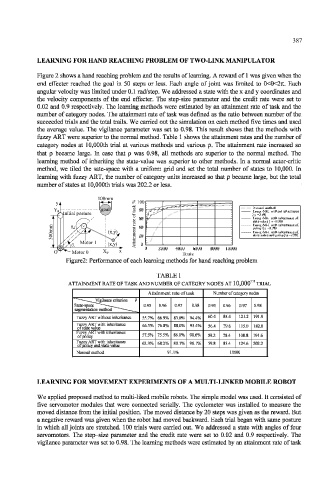
                  Figure 2 shows a hand reaching problem and the results of learning. A reward of 1 was given when the
                  end  effecter  reached  the goal  in 50 steps  or less.  Each  angle  of joint  was limited  to 0<6<2TI.  Each
                  angular velocity was limited under  0.1 rad/step. We addressed a state with the x and y coordinates and
                  the  velocity  components  of the end effecter.  The step-size  parameter  and the credit  rate  were  set to
                  0.02 and 0.9 respectively. The learning methods were  estimated by an attainment  rate of task and the
                  number of category nodes. The attainment rate of task was defined  as the ratio between number of the
                  succeeded trials and the total trails. We carried out the simulation on each method  five times and used
                  the  average  value. The vigilance  parameter was set to 0.98.  This  result  shows that the methods  with
                  fuzzy  ART were superior to the normal method. Table 1 shows the attainment rates and the number of
                  category  nodes  at  10,000th  trial at various  methods  and various p. The attainment  rate  increased so
                  that  p became  large, hi case  that  p was 0.98, all methods  are superior  to the normal  method. The
                  learning  method  of inheriting  the state-value was superior to other  methods. In a normal  actor-critic
                  method, we tiled the sate-space  with a uniform  grid  and set the total  number  of states to 10,000. In
                  learning with  fuzzy  ART, the number of category units increased  so that p became large, but the total
                  number of states at 10,000th trials was 202.2 or less.

                                   100mm
                                                                              .  Normal method
                                                                               1'uzzy ARI  without inheritam
                                                                              (,« =0.98)
                                                                              stato"valuc O  =0.98)
                                                                               Fuzzy ART  with  inheritance of
                                                                               policy (p =0.98)
                                                                              FuzzvART  willi inheritance of
                                                                              state-Value and policy! ,0-0.98)
                                                0   2000  4000  6000  8000  10000
                           - Motor 0  X g                  Trials
                          Figure2: Performance of each learning methods for hand reaching problem
                                                   TABLE 1
                           ATTAINMENT RATE OF TASK AND NUMBER OF CATEGRY NODES AT 10,000™ TRIAL
                                                 Attainment rate of task  Number of category nodes
                              —-^^Vigilance  criterion  P
                            State-space^^^^^^^^  0.95  0.96  0.97  0.98  0.95  0.96  0.97  0.98
                             segmentation method  ^ ^ - ^ ^ ^
                             Fuzzy ART without inheritance  55.7% 66.9%  83.0%  94.4%  60.4  85.4  121.2  191.0
                             Fuzzy ART with inheritance  66.5%  76.8%  88.0%  95.4%  56.4  79.6  182.8
                             ol'state value                                115.0
                             Fuzzy ARF with inheritance
                             ofpolicv          57.5%  75.5%  86.0%  90.6%  59.2  78.4  108.8  191.6
                             Fuzzy ART with inheritance  62.3%  68.2%  80.1%  90.1%  59.8  85.4  124.6  202.2
                             ofpolicv  and state value
                             Normal method             91.1%            10000


                  LEARNING FOR MOVEMENT EXPERIMENTS      OF A MULTI-LINKED MOBILE ROBOT
                  We applied proposed method to multi-liked mobile robots. The simple model was used. It consisted of
                  five  servomotor  modules  that  were  connected  serially. The cyclometer was installed to measure the
                  moved distance  from the initial position. The moved distance by 20 steps was given as the reward. But
                  a negative reward was given when the robot had moved backward. Each trial began with same posture
                  in which all joints are stretched.  100 trials were  carried  out. We addressed a state with angles of four
                  servomotors.  The step-size  parameter  and the credit  rate  were  set to 0.02 and 0.9 respectively. The
                  vigilance parameter was set to 0.98. The learning methods were estimated by an attainment  rate of task

