


Page 96 - Membranes for Industrial Wastewater Recovery and Re-Use
P. 96
76  Membranesfor Industrial  Wastewater Recovery and Re-use

         3.1 The  ower industry: water requirements for power generation
        and coo P ing water


        3.1.1  Water demand by  the power industry
        In industrialized  nations significant  quantities of  water are needed  for power
        generation  and cooling applications, greatly exceeding the quantities of  water
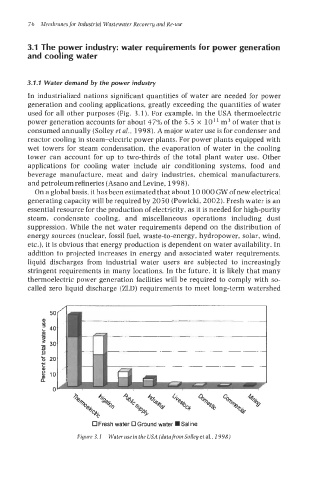
        used for all other purposes (Fig. 3.1). For example, in the USA  thermoelectric
        power generation accounts for about 47% of the 5.5 x  1011 m3 of water that is
        consumed annually (Solley et a]., 1998). A major water use is for condenser and
        reactor cooling in steam-electric  power plants. For power plants equipped with
        wet  towers  for  steam condensation, the evaporation  of  water in the cooling
        tower  can  account for  up  to  two-thirds  of  the  total  plant  water  use.  Other
         applications  for  cooling  water  include  air  conditioning  systems,  food  and
        beverage  manufacture, meat  and  dairy  industries,  chemical  manufacturers,
        and petroleum refineries (Asano and Levine, 1998).
          On a global basis, it has been estimated that about 10 000 GW of new electrical
        generating capacity will be required by 2050 (Powicki, 2002). Fresh water is an
        essential resource for the production of electricity, as it is needed for high-purity
        steam,  condensate  cooling,  and  miscellaneous  operations  including  dust
        suppression. While the net water requirements  depend on the distribution  of
        energy sources (nuclear, fossil fuel, waste-to-energy,  hydropower, solar, wind,
        etc.), it is obvious that energy production is dependent on water availability. In
        addition  to projected  increases in energy and associated water requirements,
        liquid  discharges  from  industrial  water  users  are  subjected  to  increasingly
        stringent requirements in many locations. In the future, it is likely that many
        thermoelectric  power  generation facilities will be required  to comply with  so-
        called zero liquid discharge  (ZLD)  requirements  to meet  long-term watershed


                            Fresh water 0 Ground water W Saline
                      Figure 3.1  Water use in the USA (data from Solley et al., 1998)

