


Page 113 - Methods For Monitoring And Diagnosing The Efficiency Of Catalytic Converters A Patent - oriented Survey
P. 113
Toyota Motor Co. Ltd.                      95


                              b) sensor deteriorated: Both L, and A, are small regardless of the deterioration
                                of the catalytic converter (figs. 45c,d and figs. 46.c,d)

                  Downstream oxygen sensor:
                              a) catalytic converter not deteriorated: 1) Length L2  is small regardless of the
                                deterioration of the downstream sensor (figs. 45a-d)  2) Area A2 is large for
                                non-deteriorated oxygen sensor (figs. 45%~) and is medium for deteriorated
                                downstream oxygen sensor (figs. 45b,d)
                              b) catalytic  converter  deteriorated:  1)  Both  L2  and  A2  are  large  for  non-
                                deteriorated downstream oxygen sensor (figs. 46a,c)  2) L2  is medium  and
                                A2 is small for deteriorated downstream oxygen sensor (figs. 46b,d)
                  The ratios of lengths and areas are calculated and shown to the two right columns of fig. 45
                  and  fig. 46. The combination of these ratios gives an accurate estimation of the condition of
                  the catalytic converter.

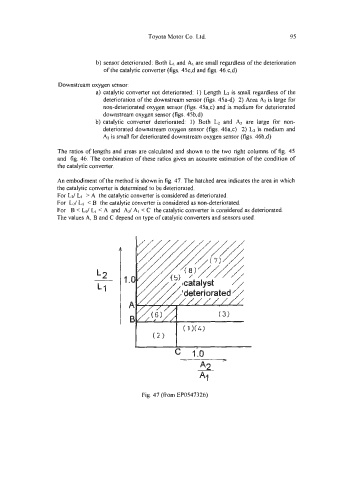
                   An embodiment of the method is shown in fig. 47. The hatched area indicates the area in which
                  the catalytic converter is determined to be deteriorated.
                   For L2/  L,  > A  the catalytic converter is considered as deteriorated.
                   For  Lz/ Lt  < B  the catalytic converter is considered as non-deteriorated.
                   For  B < L2/ L1 < A  and  AZ/ AI < C  the catalytic converter is considered as deteriorated.
                  The values A, B and C depend on type of catalytic converters and sensors used.


                                             Fig. 47 (from EP0547326)

