


Page 208 - Methods For Monitoring And Diagnosing The Efficiency Of Catalytic Converters A Patent - oriented Survey
P. 208
190   Methods for Monitoring and Diagnosing the Efficiency of Catalytic Converters


                1)  calculating individual  integration values (S) corresponding to  areas enclosed  by  output
                  signals of the upstream and  downstream oxygen sensors and  designated signals (fig. 85),
                  wherein  a  designated  signal  for  the  upstream  sensor  is  variable in  accordance with  the
                  output signal of the downstream sensor, and the integration values are calculated for areas
                  both above and below an associated designated signal. The designated signals are corrected
                  by a hysteresis factor
                2) determining variable, individual time periods (T) between which the output signals reverse
                  polarity with respect to the designated signals
                3) calculating a parameter (C) for determining deterioration of the catalytic converter based on
                  one of mean values and summation values of one of the integration values and the polarity
                  reversal time periods in a predetermined time
                4) determining deterioration of  the catalytic converter by  comparing said  parameter with  a
                  predetermined value (CS,)
                5) issuing an alarm when the catalytic converter is determined as deteriorated


                More specifically the parameter (C) can be calculated by one of the following methods:
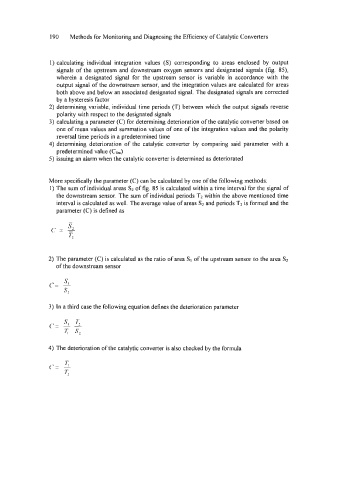
                1)  The sum of individual areas SZ of fig. 85 is calculated within a time interval for the signal of
                  the downstream sensor. The sum of individual periods TZ within the above mentioned time
                  interval is calculated as well. The average value of areas Sz and periods TZ is formed and the
                  parameter (C) is defined as


                2) The parameter (C) is calculated as the ratio of area SI of the upstream sensor to the area SZ
                  of the downstream sensor


                3) In a third case the following equation defines the deterioration parameter


                4) The deterioration of the catalytic converter is also checked by the formula

