


Page 204 - Methods For Monitoring And Diagnosing The Efficiency Of Catalytic Converters A Patent - oriented Survey
P. 204
186   Methods for Monitoring and Diagnosing the Eficiency of Catalytic Converters


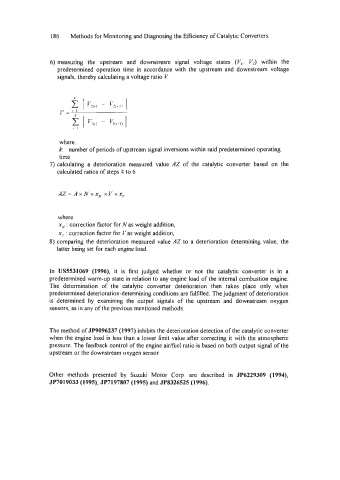
                6) measuring  the  upstream  and  downstream  signal  voltage  states  (VI,  V2) within  the
                  predetermined operation  time  in  accordance with  the upstream and  downstream voltage
                  signals, thereby calculating a voltage ratio Y


                   where:
                   k  number of periods of upstream signal inversions within said predetermined operating
                   time
                7) calculating a  deterioration measured  value AZ  of  the  catalytic  converter  based  on  the
                  calculated ratios of steps 4 to 6


                   AZ=AXNXX, XVXX,,


                  where
                   x,  : correction factor for N as weight addition,
                   x,, : correction factor for C'as  weight addition,
                8) comparing the deterioration measured  value AZ to a deterioration determining value, the
                  latter being set  for each engine load.


                In  US5531069 (1996), it  is  first  judged  whether  or  not  the  catalytic  converter  is  in  a
                predetermined warm-up state in relation to any engine load of the internal combustion engine.
                The  determination  of  the  catalytic  converter  deterioration  then  takes  place  only  when
                predetermined deterioration-determining conditions are fklfilled. The judgment of deterioration
                is  determined by  examining  the  output  signals  of  the  upstream  and  downstream  oxygen
                sensors, as in any of the previous mentioned methods.


                The method of JP9096237 (1997) inhibits the deterioration detection of the catalytic converter
                when the engine load is less than a lower limit value after correcting it with the atmospheric
                pressure. The feedback control of the engine airhe1 ratio is based on both output signal of the
                upstream or the downstream oxygen sensor


                Other  methods  presented  by  Suzuki  Motor  Corp.  are  described  in  JP6229309 (1994),
                JP7019033 (1995), 337197807 (1995)  and JP8326525 (1996).

