


Page 203 - Methods For Monitoring And Diagnosing The Efficiency Of Catalytic Converters A Patent - oriented Survey
P. 203
Suzuki Motor Corporation                    185


                     where:
                                      a) the lean response delay time Ta elapses fiom the beginning of a
                                        decrease (point “b) in  an  upstream feedback control-corrected
                                        quantity to a lean inversion  time (point  “e”) of the downstream
                                        detection  signal  in  response  to  rich  and  lean  inversions of  the
                                        upstream detection signal (fig. 82)
                                      b) the rich response delay time T1.K  elapses fiom the beginning of  an
                                        increase (point  “f ’)  in  an  upstream  feedback control-corrected
                                        quantity to  a rich  inversion  time (point “g”) of the  downstream
                                        detection  signal  in  response  to  rich  and  lean  inversions of  the
                                        upstream detection signal (figs. 82a-c)
                                      c)  the rich determination delay time ATLR and the lean determination
                                        delay  time  ATm, are defined  in  the above mentioned  method of
                                        US5379587 (1 995).
                  4) repeating previous step for a certain number of times
                  5) calculating the standard deviation of TDLY  and  if  the dispersion is smaller than  a preset
                    value then
                  6) calculating an average value of TDLY and correcting it in fbnction of the engine air intake
                    quantity and the period of feedback control Tw (fig. 82b) and comparing the average value
                    of TDLY to a predetermined value
                  7) considering the  catalytic converter as deteriorated when  the  corrected  average value of
                    TDLY is equal or less than the predetermined value.


                  The method of CAt153606 (1996) comprises the following steps:
                  1)  feedback-controlling the engine aidfbel ratio in accordance with the signal of the upstream
                    sensor (first feedback control) to achieve a target value
                  2) feedback-controlling the engine air/fbel ratio so as to correct the first feedback control in
                    accordance with the signal of the downstream sensor (second feedback control)
                  3 ) establishing predetermined catalytic converter deterioration-determining conditions
                  4) measuring the number of successive oscillations of the upstream and  downstream sensor
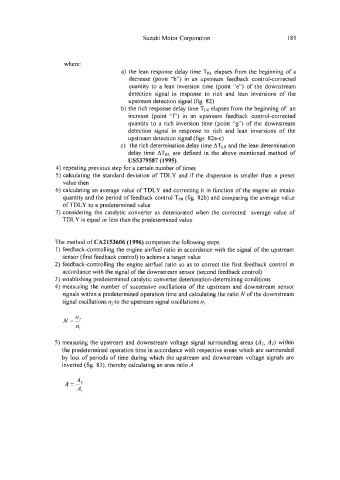
                    signals within a predetermined operation time and calculating the ratio N of the downstream
                    signal oscillations  it2 to the upstream signal oscillations n1


                  5) measuring the upstream and  downstream voltage signal surrounding areas (AI,  A2) within
                    the predetermined operation time in accordance with respective areas which are surrounded
                    by  loci of periods of time during which  the upstream and  downstream voltage signals are
                    inverted (fig. 83), thereby calculating an area ratio A

