


Page 289 - Methods For Monitoring And Diagnosing The Efficiency Of Catalytic Converters A Patent - oriented Survey
P. 289
Ford Motor Co. - Ford France SA - Ford Werke AG - Ford Motor Co. Ltd.   271


                   converter, after 5 seconds most of the temperature increase is concentrated at the front end of
                  the catalytic  converter  and  this  front  slice is  considerably hotter  than  the  remainder  of the
                   converter. On the other hand, in the case of an inefficient converter, the temperature rise at the
                  front  end  of the  converter  after  5  seconds is  significantly lower than  the  temperature  rise
                  deeper  within  the  converter.  For  efficient  converters,  the  exothermic  catalytic  reaction  is
                  completed while the exhaust gases are still at the front end  of the converter whereas in a less
                  efficient converter the exothermic reaction takes longer to complete. The exhaust  gases also
                  tend to coof  the catalytic converter and the cooling effect is strongest  at the front end of the
                  catalytic converter. As a result after 5 seconds the front end of a converter operating with 60%
                  efficiency is cooler than the center of the converter.

                  It is therefore possible measuring the temperature in different slices of the catalytic converter
                  to determine the conversion efficiency by  a  comparison of the  relative temperatures  after  a
                  given  time  following  a  step  increase  in  the  combustible constituents  of the  exhaust  gases
                  reaching the catalytic converter.


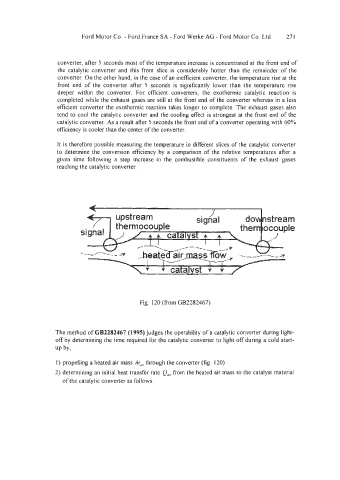
                                           Fig. 120 (from GB2282467)


                  The method of GB2282467 (1 995) judges the operability of a catalytic converter during light-
                  off by determining the time required for the catalytic converter to light off during a cold start-
                  UP by7

                  1)  propelling a heated air mass   through the converter (fig. 120)
                  2) determining an initial heat transfer rate  &,,from  the heated air mass to the catalyst material
                    of the catalytic converter as follows:

