


Page 290 - Methods For Monitoring And Diagnosing The Efficiency Of Catalytic Converters A Patent - oriented Survey
P. 290
272    Methods for Monitoring and Diagnosing the Eficiency of Catalytic Converters


                   where
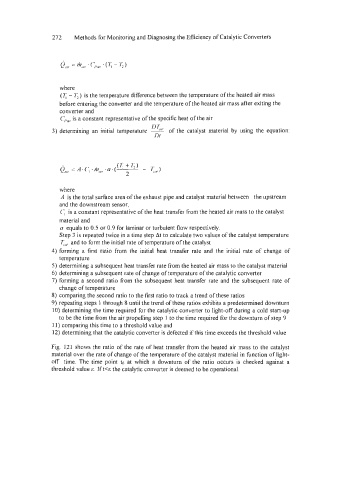
                   (7; - T,)  is the temperature difference between the temperature of the heated air mass
                   before entering the converter and the temperature of the heated air mass after exiting the
                   converter and
                   C,,.,, is a constant representative of the specific heat of the air
                                               I1
                                                    of
                 3) determining  an  initial temperature  - the  catalyst  material by  using  the  equation:
                                                Dt


                   where
                   A  is the total surface area of the exhaust pipe and catalyst material between  the upstream
                   and the downstream sensor,
                   C, is a constant representative of the heat transfer from the heated air mass to the catalyst
                   material and
                   a equals to 0.5 or 0.9 for laminar or turbulent flow respectively.
                   Step 3 is repeated twice in a time step At to calculate two values of the catalyst temperature
                    7L0, and to form the initial rate of temperature of the catalyst
                 4) forming  a first  ratio  from  the initial heat  transfer  rate  and  the  initial  rate  of  change  of
                   temperature
                 5) determining a subsequent heat transfer rate from the heated air mass to the catalyst material
                 6) determining a subsequent rate of change of temperature of the catalytic converter
                 7) forming a second  ratio from the subsequent heat transfer rate  and the subsequent  rate of
                   change of temperature
                 8) comparing the second ratio to the first ratio to track a trend of these ratios
                 9) repeating steps 1 through 8 until the trend of these ratios exhibits a predetermined downturn
                 IO) determining the time required for the catalytic converter to light-off during a cold start-up
                   to be the time from the air propelling step 1 to the time required for the downturn of step 9
                 11) comparing this time to a threshold value and
                 12) determining that the catalytic converter is defected if this time exceeds the threshold value
                 Fig.  121 shows the ratio of the rate of heat transfer from the heated air mass to the catalyst
                 material over the rate of change of the temperature of the catalyst material in knction of light-
                 off  time.  The time  point  to  at  which  a  downturn  of the  ratio  occurs  is  checked  against  a
                 threshold value E. If t<E the catalytic converter is deemed to be operational.

