


Page 302 - Methods For Monitoring And Diagnosing The Efficiency Of Catalytic Converters A Patent - oriented Survey
P. 302
284   Methods for Monitoring and Diagnosing the Efficiency of Catalytic Converters


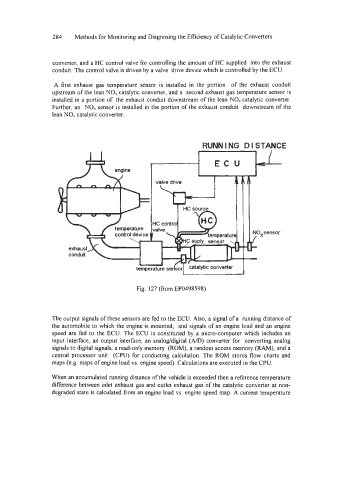
                 converter, and a HC control valve for controlling the amount of HC supplied  into the exhaust
                 conduit. The control valve is driven by a valve  drive device which is controlled by the ECU.
                 A  first  exhaust  gas  temperature  sensor  is  installed in  the  portion  of  the  exhaust  conduit
                 upstream of the lean NO,  catalytic converter, and a  second exhaust gas temperature sensor is
                 installed in a portion  of  the exhaust conduit downstream of the lean NOx catalytic converter.
                 Further, an  NO,  sensor is installed in the portion of the exhaust conduit  downstream of the
                 lean NO,  catalytic converter.


                                          Fig. 127 (from EP0498598)


                 The output signals of these sensors are fed to the ECU. Also, a signal of a  running distance of
                 the automobile to which the engine is mounted,  and signals of an engine load and an engine
                 speed  are fed to the ECU.  The ECU  is constituted  by  a micro-computer  which includes  an
                input interface, an output  interface, an analoddigital  (ND) converter for  converting analog
                 signals to digital signals, a read-only memory  (ROM), a random access memory (RAM), and a
                central  processor  unit  (CPU) for conducting  calculation. The ROM stores flow charts  and
                maps (e.g. maps of engine load vs. engine speed). Calculations are executed in the CPU.

                When an accumulated running distance of the vehicle is exceeded then a reference temperature
                difference between  inlet exhaust gas and outlet exhaust gas of the catalytic converter at non-
                degraded state is calculated from an engine load vs. engine speed map. A current temperature

