


Page 299 - Methods For Monitoring And Diagnosing The Efficiency Of Catalytic Converters A Patent - oriented Survey
P. 299
Siemens  -  Bayerische Motoren Werke  - Mercedes Benz   28 1


                  3)  measuring the temperature  T2  of the heated  exhaust  gases between  the burner  and  the
                     catalytic converter at a time point t2
                  4)  comparing the measured temperature T2 with a predetermined threshold To
                  5)  determining that the system is deteriorated when Tz<To.

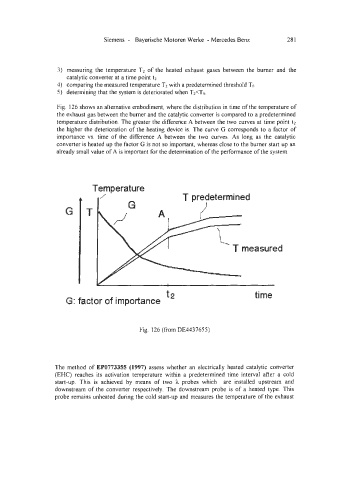
                  Fig. 126 shows an alternative embodiment, where the distribution in time of the temperature of
                  the exhaust gas between the burner and the catalytic converter is compared to a Predetermined
                  temperature distribution. The greater the difference A between the two curves at time point t2
                  the higher the deterioration of the heating device is. The curve G corresponds to a factor of
                  importance vs.  time  of the  difference  A  between  the  two  curves.  As  long  as the  catalytic
                  converter is heated up the factor G is not so important, whereas close to the burner start up an
                  already small value of A is important for the determination of the performance of the system.


                             Temperature


                     G  T


                                                   f2                         time
                     G: factor of importance


                                           Fig. 126 (from DE4437655)


                  The method  of EP0773355 (1997) assess whether  an  electrically heated  catalytic  converter
                  (EHC) reaches  its activation temperature  within  a  predetermined  time  interval  after  a  cold
                  start-up.  This  is  achieved  by  means  of  two  h probes  which  are  installed  upstream  and
                  downstream of the converter respectively. The downstream  probe  is of a  heated  type.  This
                  probe remains unheated during the cold start-up and measures the temperature of the exhaust

