


Page 298 - Methods For Monitoring And Diagnosing The Efficiency Of Catalytic Converters A Patent - oriented Survey
P. 298
280    Methods for Monitoring and Diagnosing the Eficiency of Catalytic Converters


                The method of W09517588 (1995) monitors the condition of a secondary catalytic converter
                installed upstream of a main catalytic converter and comprises the following steps:
                1)  measuring  the  temperature  downstream  of  the  secondary  catalytic  converter  at  the
                   beginning and end of a predetermined  idling phase, over a predetermined number of idling
                   phases, following a power phase under predetermined operating conditions of the engine
                2)  forming the temperature difference between  the temperatures measured  at  the beginning
                   and end of each predetermined idling phase
                3)  forming the sum of the results of temperature differences calculating the total duration of
                   the idling phases
                4)  forming an average temperature quotient from the sum of temperature differences and the
                   total duration of the idling phases
                5)  comparing the average temperature gradient thus formed with a predetermined threshold
                6)  assessing  the  deterioration  of  the  catalytic  converter  when  the  average  temperature
                   gradient is higher than the predetermined threshold


                                   -
                          I- -- ----
                     . -...
                     Temaera tiire
                              t                            efficient c


                               I  l/\di eteriorated converter


                                                   t2                  time


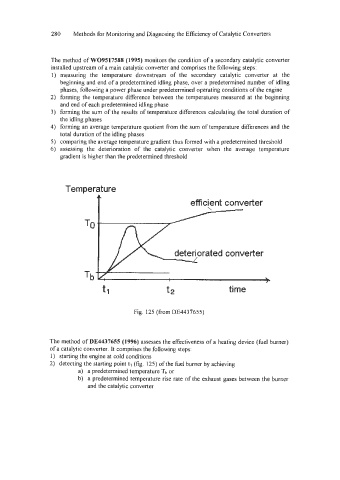
                                          Fig. 125 @om DE4437655)


                The method of DE4437655 (1996) assesses the effectiveness of a heating device (fuel burner)
                of a catalytic converter. It comprises the following steps:
                1)  starting the engine at cold conditions
                2)  detecting the starting point tl (fig. 125) ofthe fuel burner by achieving
                         a)  a predetermined temperature Th  or
                         b)  a predetermined temperature rise rate of the exhaust  gases between the burner
                            and the catalytic converter

