


Page 297 - Methods For Monitoring And Diagnosing The Efficiency Of Catalytic Converters A Patent - oriented Survey
P. 297
Siemens  -  Bayerische Motoren Werke  - Mercedes Benz   279


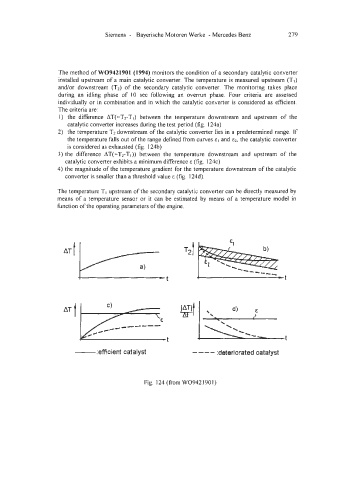
                   The method of W09421901 (1994) monitors the condition of a secondary catalytic converter
                   installed  upstream of a main  catalytic converter. The temperature is measured  upstream (TI)
                   andor  downstream (T2)  of  the  secondary catalytic converter. The  monitoring takes  place
                   during  an  idling  phase  of  10  sec  following  an  overrun  phase.  Four  criteria  are  assessed
                   individually or in combination  and  in which the catalytic converter is considered as efficient.
                   The criteria are:
                   1)  the  difference AT(=Tz-Tl)  between  the  temperature  downstream and  upstream  of  the
                      catalytic converter increases during the test period (fig. 124a)
                   2)  the temperature Tz downstream of the catalytic converter lies in a predetermined range. If
                     the temperature falls out of the range defined from curves   and  E~, the catalytic converter
                     is considered as exhausted (fig. 124b)
                   3) the  difference AT(=T2-TI)) between  the  temperature  downstream and  upstream  of  the
                     catalytic converter exhibits a minimum difference E (fig. 124c)
                   4) the magnitude of the temperature gradient for the temperature downstream of the catalytic
                     converter is smaller than a threshold value E (fig. 124d).

                  The temperature TI upstream of the secondary catalytic converter can be directly measured  by
                   means of a temperature sensor or it  can  be  estimated by  means  of  a temperature model  in
                  function of the operating parameters of the engine.


                                                         T2 t


                                                                                       t


                                                    t
                              :efficient catalyst          ---- :deteriorated catalyst


                                             Fig. 124 (from W09421901)

