


Page 221 - Microtectonics
P. 221
7.6  ·  Problematic Porphyroblast Microstructures  211
                 centre of grains of B, or if single grains of A are rimmed  7.6.7
                 by coronas of B (Sect. 7.8). Figure 7.30 shows an example  Discontinuous S  and S e
                                                                           i
                 where either staurolite or garnet start growing. In the fi-
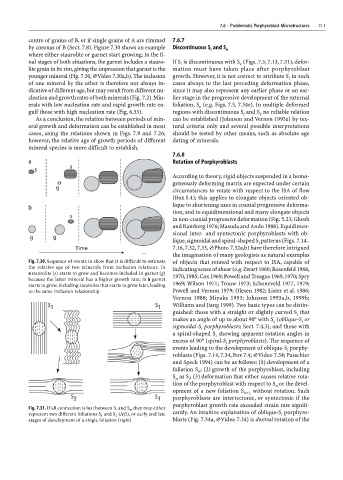
                 nal stages of both situations, the garnet includes a stauro-  If S  is discontinuous with S  (Figs. 7.5, 7.13, 7.31), defor-
                                                                 i                  e
                 lite grain in its rim, giving the impression that garnet is the  mation must have taken place after porphyroblast
                 younger mineral (Fig. 7.30, ×Video 7.30a,b). The inclusion  growth. However, it is not correct to attribute S  in such
                                                                                                    i
                 of one mineral by the other is therefore not always in-  cases always to the last preceding deformation phase,
                 dicative of different age, but may result from different nu-  since it may also represent any earlier phase or an ear-
                 cleation and growth rates of both minerals (Fig. 7.2). Min-  lier stage in the progressive development of the external
                 erals with low nucleation rate and rapid growth rate en-  foliation, S  (e.g. Figs. 7.5, 7.34e). In multiple deformed
                                                                       e
                 gulf those with high nucleation rate (Fig. 6.33).  regions with discontinuous S  and S  no reliable relation
                                                                                     i     e
                   As a conclusion, the relation between periods of min-  can be established (Johnson and Vernon 1995a) by tex-
                 eral growth and deformation can be established in most  tural criteria only and several possible interpretations
                 cases, using the relations shown in Figs. 7.9 and 7.26;  should be tested by other means, such as absolute age
                 however, the relative age of growth periods of different  dating of minerals.
                 mineral species is more difficult to establish.
                                                               7.6.8
                                                               Rotation of Porphyroblasts
                                                               According to theory, rigid objects suspended in a homo-
                                                               geneously deforming matrix are expected under certain
                                                               circumstances to rotate with respect to the ISA of flow
                                                               (Box 5.4); this applies to elongate objects oriented ob-
                                                               lique to shortening axes in coaxial progressive deforma-
                                                               tion, and to equidimensional and many elongate objects
                                                               in non-coaxial progressive deformation (Fig. 5.23; Ghosh
                                                               and Ramberg 1976; Masuda and Ando 1988). Equidimen-
                                                               sional inter- and syntectonic porphyroblasts with ob-
                                                               lique, sigmoidal and spiral-shaped S  patterns (Figs. 7.14–
                                                                                          i
                                                               7.16, 7.32, 7.33, ×Photo 7.32a,b) have therefore intrigued
                                                               the imagination of many geologists as natural examples
                 Fig. 7.30. Sequence of events to show that it is difficult to estimate  of objects that rotated with respect to ISA, capable of
                 the relative age of two minerals from inclusion relations.  In  indicating sense of shear (e.g. Zwart 1960; Rosenfeld 1968,
                 a staurolite (s) starts to grow and becomes included in garnet (g)  1970, 1985; Cox 1969; Powell and Treagus 1969, 1970; Spry
                 because the latter mineral has a higher growth rate; in b garnet
                 starts to grow, including staurolite that starts to grow later, leading  1969; Wilson 1971; Trouw 1973; Schoneveld 1977, 1979;
                 to the same inclusion relationship            Powell and Vernon 1979; Olesen 1982; Lister et al. 1986;
                                                               Vernon 1988; Miyake 1993; Johnson 1993a,b, 1999b;
                                                               Williams and Jiang 1999). Two basic types can be distin-
                                                               guished: those with a straight or slightly curved S  that
                                                                                                      i
                                                               makes an angle of up to about 90° with S  (oblique-S  or
                                                                                                        i
                                                                                               e
                                                               sigmoidal-S  porphyroblasts; Sect. 7.4.3), and those with
                                                                        i
                                                               a spiral-shaped S  showing apparent rotation angles in
                                                                             i
                                                               excess of 90° (spiral-S  porphyroblasts). The sequence of
                                                                                i
                                                               events leading to the development of oblique-S  porphy-
                                                                                                   i
                                                               roblasts (Figs. 7.14, 7.34, Box 7.4; ×Video 7.34; Passchier
                                                               and Speck 1994) can be as follows: (1) development of a
                                                               foliation S ; (2) growth of the porphyroblast, including
                                                                       n
                                                               S  as S ; (3) deformation that either causes relative rota-
                                                                n
                                                                    i
                                                               tion of the porphyroblast with respect to S  or the devel-
                                                                                                n
                                                               opment of a new foliation S n+1  without rotation. Such
                                                               porphyroblasts are intertectonic, or syntectonic if the
                                                               porphyroblast growth rate exceeded strain rate signifi-
                 Fig. 7.31. If all connection is lost between S i  and S e , they may either
                 represent two different foliations S  and S  (left), or early and late  cantly. An intuitive explanation of oblique-S  porphyro-
                                                                                                 i
                                        1
                                             2
                 stages of development of a single foliation (right)  blasts (Fig. 7.34a, ×Video 7.34) is dextral rotation of the

