


Page 222 - Microtectonics
P. 222
212   7  ·  Porphyroblasts and Reaction Rims


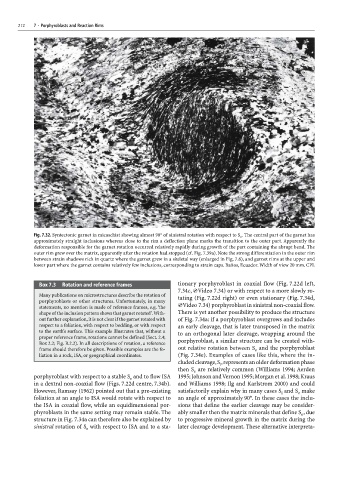
                   Fig. 7.32. Syntectonic garnet in micaschist showing almost 90° of sinistral rotation with respect to S . The central part of the garnet has
                                                                                    e
                   approximately straight inclusions whereas close to the rim a deflection plane marks the transition to the outer part. Apparently the
                   deformation responsible for the garnet rotation occurred relatively rapidly during growth of the part containing the abrupt bend. The
                   outer rim grew over the matrix, apparently after the rotation had stopped (cf. Fig. 7.39a). Note the strong differentiation in the outer rim
                   between strain shadows rich in quartz where the garnet grew in a skeletal way (enlarged in Fig. 7.6), and garnet rims at the upper and
                   lower part where the garnet contains relatively few inclusions, corresponding to strain caps. Baños, Ecuador. Width of view 20 mm. CPL


                    Box 7.3  Rotation and reference frames      tionary porphyroblast in coaxial flow (Fig. 7.22d left,
                                                                7.34c, ×Video 7.34) or with respect to a more slowly ro-
                    Many publications on microstructures describe the rotation of
                    porphyroblasts or other structures. Unfortunately, in many  tating (Fig. 7.22d right) or even stationary (Fig. 7.34d,
                    statements, no mention is made of reference frames, e.g. ‘the  ×Video 7.34) porphyroblast in sinistral non-coaxial flow.
                    shape of the inclusion pattern shows that garnet rotated’. With-  There is yet another possibility to produce the structure
                    out further explanation, it is not clear if the garnet rotated with  of Fig. 7.34a: if a porphyroblast overgrows and includes
                    respect to a foliation, with respect to bedding, or with respect  an early cleavage, that is later transposed in the matrix
                    to the earth’s surface. This example illustrates that, without a  to an orthogonal later cleavage, wrapping around the
                    proper reference frame, rotations cannot be defined (Sect. 2.4;
                    Box 2.2; Fig. B.2.2). In all descriptions of rotation, a reference  porphyroblast, a similar structure can be created with-
                    frame should therefore be given. Possible examples are the fo-  out relative rotation between S  and the porphyroblast
                                                                                         e
                    liation in a rock, ISA, or geographical coordinates.  (Fig. 7.34e). Examples of cases like this, where the in-
                                                                cluded cleavage, S , represents an older deformation phase
                                                                              i
                                                                then S  are relatively common (Williams 1994; Aerden
                                                                      e
                   porphyroblast with respect to a stable S  and to flow ISA  1995; Johnson and Vernon 1995; Morgan et al. 1998; Kraus
                                                 e
                   in a dextral non-coaxial flow (Figs. 7.22d centre, 7.34b).  and Williams 1998; Ilg and Karlstrom 2000) and could
                   However, Ramsay (1962) pointed out that a pre-existing  satisfactorily explain why in many cases S  and S  make
                                                                                                 i
                                                                                                       e
                   foliation at an angle to ISA would rotate with respect to  an angle of approximately 90°. In these cases the inclu-
                   the ISA in coaxial flow, while an equidimensional por-  sions that define the earlier cleavage may be consider-
                   phyroblasts in the same setting may remain stable. The  ably smaller then the matrix minerals that define S , due
                                                                                                        e
                   structure in Fig. 7.34a can therefore also be explained by  to progressive mineral growth in the matrix during the
                   sinistral rotation of S  with respect to ISA and to a sta-  later cleavage development. These alternative interpreta-
                                   e

