


Page 225 - Microtectonics
P. 225
7.6  ·  Problematic Porphyroblast Microstructures  215
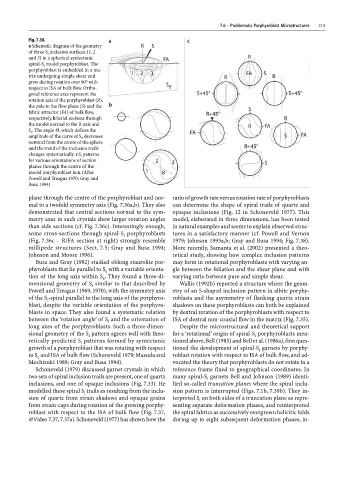
                 Fig. 7.36.
                 a Schematic diagram of the geometry
                 of three S  inclusion surfaces (1, 2
                       i
                 and 3) in a spherical syntectonic
                 spiral-S i  model porphyroblast. The
                 porphyroblast is embedded in a ma-
                 trix undergoing simple shear and
                 grew during rotation over 90° with
                 respect to ISA of bulk flow. Ortho-
                 gonal reference axes represent the
                 rotation axis of the porphyroblast (R),
                 the pole to the flow plane (S) and the
                 fabric attractor (FA) of bulk flow,
                 respectively. b Serial sections through
                 the model normal to the R-axis and
                 S e . The angle Θ, which defines the
                 amplitude of the curve of S , decreases
                                  i
                 outward from the centre of the sphere
                 and the trend of the inclusion trails
                 changes systematically. c S  patterns
                                  i
                 for various orientations of section
                 planes through the centre of the
                 model porphyroblast in a. (After
                 Powell and Treagus 1970; Gray and
                 Busa 1994)

                 plane through the centre of the porphyroblast and nor-  ratio of growth rate versus rotation rate of porphyroblasts
                 mal to a twofold symmetry axis (Fig. 7.36a,b). They also  can determine the shape of spiral trails of quartz and
                 demonstrated that central sections normal to the sym-  opaque inclusions (Fig. 12 in Schoneveld 1977). This
                 metry axes in such crystals show larger rotation angles  model, elaborated in three dimensions, has been tested
                 than side sections (cf. Fig. 7.36c). Interestingly enough,  in natural examples and seems to explain observed struc-
                 some cross-sections through spiral-S  porphyroblasts  tures in a satisfactory manner (cf. Powell and Vernon
                                               i
                 (Fig. 7.36c – R/FA section at right) strongly resemble  1979; Johnson 1993a,b; Gray and Busa 1994; Fig. 7.38).
                 millipede structures (Sect. 7.5; Gray and Busa 1994;  More recently, Samanta et al. (2002) presented a theo-
                 Johnson and Moore 1996).                      retical study, showing how complex inclusion patterns
                   Busa and Gray (1992) studied oblong staurolite por-  may form in rotational porphyroblasts with varying an-
                 phyroblasts that lie parallel to S  with a variable orienta-  gle between the foliation and the shear plane and with
                                         e
                 tion of the long axis within S . They found a three-di-  varying ratio between pure and simple shear.
                                         e
                 mensional geometry of S  similar to that described by  Wallis (1992b) reported a structure where the geom-
                                     i
                 Powell and Treagus (1969, 1970), with the symmetry axis  etry of an S-shaped inclusion pattern in albite porphy-
                 of the S -spiral parallel to the long axis of the porphyro-  roblasts and the asymmetry of flanking quartz strain
                       i
                 blast, despite the variable orientation of the porphyro-  shadows on these porphyroblasts can both be explained
                 blasts in space. They also found a systematic relation  by dextral rotation of the porphyroblasts with respect to
                 between the ‘rotation angle’ of S  and the orientation of  ISA of dextral non-coaxial flow in the matrix (Fig. 7.35).
                                          i
                 long axes of the porphyroblasts. Such a three-dimen-  Despite the microstructural and theoretical support
                 sional geometry of the S  pattern agrees well with theo-  for a ‘rotational’ origin of spiral-S  porphyroblasts men-
                                    i
                                                                                         i
                 retically predicted S  patterns formed by syntectonic  tioned above, Bell (1985) and Bell et al. (1986a), first ques-
                                  i
                 growth of a porphyroblast that was rotating with respect  tioned the development of spiral-S  garnets by porphy-
                                                                                          i
                 to S  and ISA of bulk flow (Schoneveld 1979; Masuda and  roblast rotation with respect to ISA of bulk flow, and ad-
                    e
                 Mochizuki 1989; Gray and Busa 1994).          vocated the theory that porphyroblasts do not rotate in a
                   Schoneveld (1979) discussed garnet crystals in which  reference frame fixed to geographical coordinates. In
                 two sets of spiral inclusion trails are present, one of quartz  many spiral-S  garnets Bell and Johnson (1989) identi-
                                                                          i
                 inclusions, and one of opaque inclusions (Fig. 7.33). He  fied so-called truncation planes where the spiral inclu-
                 modelled these spiral S  trails as resulting from the inclu-  sion pattern is interrupted (Figs. 7.1b, 7.39b). They in-
                                   i
                 sion of quartz from strain shadows and opaque grains  terpreted S  on both sides of a truncation plane as repre-
                                                                       i
                 from strain-caps during rotation of the growing porphy-  senting separate deformation phases, and reinterpreted
                 roblast with respect to the ISA of bulk flow (Fig. 7.37,  the spiral fabrics as successively overgrown helicitic folds
                 ×Video 7.37, 7.37a). Schoneveld (1977) has shown how the  during up to eight subsequent deformation phases, in-

