


Page 229 - Microtectonics
P. 229
7.6  ·  Problematic Porphyroblast Microstructures  219
                   Schoneveld (1979) has described a number of garnets  pens with garnet the amalgamated crystals may be eas-
                 that are rotational with relation to a progressively devel-  ily mistaken for one big porphyroblast, possibly leading
                 oping crenulation cleavage. This leads to fairly compli-  to an erroneous interpretation of the inclusion pattern.
                 cated inclusion patterns that, judging from the literature,  An example of this type of structure occurs in garnet
                 are not very common in nature. In Box 7.4, a short list of  porphyroblasts from a chloritoid-garnet schist that crops
                 criteria is given that may help to distinguish between  out in the south of Minas Gerais State, Brazil. The schist
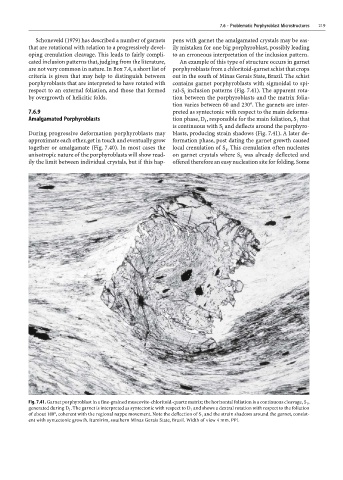
                 porphyroblasts that are interpreted to have rotated with  contains garnet porphyroblasts with sigmoidal to spi-
                 respect to an external foliation, and those that formed  ral-S  inclusion patterns (Fig. 7.41). The apparent rota-
                                                                   i
                 by overgrowth of helicitic folds.             tion between the porphyroblasts and the matrix folia-
                                                               tion varies between 60 and 230°. The garnets are inter-
                 7.6.9                                         preted as syntectonic with respect to the main deforma-
                 Amalgamated Porphyroblasts                    tion phase, D , responsible for the main foliation, S  that
                                                                         1
                                                                                                      1
                                                               is continuous with S  and deflects around the porphyro-
                                                                               i
                 During progressive deformation porphyroblasts may  blasts, producing strain shadows (Fig. 7.41). A later de-
                 approximate each other, get in touch and eventually grow  formation phase, post dating the garnet growth caused
                 together or amalgamate (Fig. 7.40). In most cases the  local crenulation of S . This crenulation often nucleates
                                                                                1
                 anisotropic nature of the porphyroblasts will show read-  on garnet crystals where S  was already deflected and
                                                                                    1
                 ily the limit between individual crystals, but if this hap-  offered therefore an easy nucleation site for folding. Some


                 Fig. 7.41. Garnet porphyroblast in a fine-grained muscovite-chloritoid-quartz matrix; the horizontal foliation is a continuous cleavage, S , 1
                 generated during D 1 . The garnet is interpreted as syntectonic with respect to D 1  and shows a dextral rotation with respect to the foliation
                 of about 180°, coherent with the regional nappe movement. Note the deflection of S  and the strain shadows around the garnet, consist-
                                                                        1
                 ent with syntectonic growth. Itumirim, southern Minas Gerais State, Brazil. Width of view 4 mm. PPL

