


Page 230 - Microtectonics
P. 230
220   7  ·  Porphyroblasts and Reaction Rims


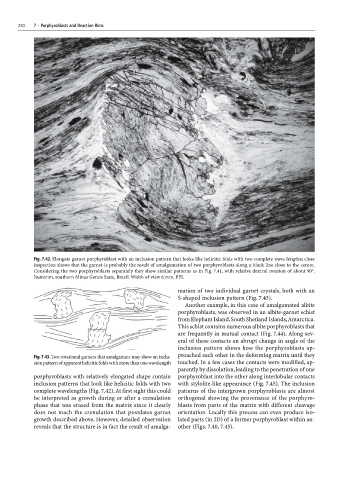
                   Fig. 7.42. Elongate garnet porphyroblast with an inclusion pattern that looks like helicitic folds with two complete wave-lengths; close
                   inspection shows that the garnet is probably the result of amalgamation of two porphyroblasts along a black line close to the centre.
                   Considering the two porphyroblasts separately they show similar patterns as in Fig. 7.41, with relative dextral rotation of about 90°.
                   Itumirim, southern Minas Gerais State, Brazil. Width of view 6 mm. PPL

                                                                mation of two individual garnet crystals, both with an
                                                                S-shaped inclusion pattern (Fig. 7.43).
                                                                   Another example, in this case of amalgamated albite
                                                                porphyroblasts, was observed in an albite-garnet schist
                                                                from Elephant Island, South Shetland Islands, Antarctica.
                                                                This schist contains numerous albite porphyroblasts that
                                                                are frequently in mutual contact (Fig. 7.44). Along sev-
                                                                eral of these contacts an abrupt change in angle of the
                                                                inclusion pattern shows how the porphyroblasts ap-
                   Fig. 7.43. Two rotational garnets that amalgamate may show an inclu-  proached each other in the deforming matrix until they
                   sion pattern of apparent helicitic folds with more than one wavelength  touched. In a few cases the contacts were modified, ap-
                                                                parently by dissolution, leading to the penetration of one
                   porphyroblasts with relatively elongated shape contain  porphyroblast into the other along interlobular contacts
                   inclusion patterns that look like helicitic folds with two  with stylolite-like appearance (Fig. 7.45). The inclusion
                   complete wavelengths (Fig. 7.42). At first sight this could  patterns of the intergrown porphyroblasts are almost
                   be interpreted as growth during or after a crenulation  orthogonal showing the provenance of the porphyro-
                   phase that was erased from the matrix since it clearly  blasts from parts of the matrix with different cleavage
                   does not mach the crenulation that postdates garnet  orientation. Locally this process can even produce iso-
                   growth described above. However, detailed observation  lated parts (in 2D) of a former porphyroblast within an-
                   reveals that the structure is in fact the result of amalga-  other (Figs. 7.40, 7.45).

