


Page 234 - Microtectonics
P. 234
224   7  ·  Porphyroblasts and Reaction Rims
           7.7     7.7                                          diffusion rate and crystal growth rate due to changing
                   Crystallographically Determined Inclusion Patterns  metamorphic conditions, possibly related to a growth in-
                                                                terval. However, it may also be due to a change in the por-
                   Passive inclusion as described in Sects. 7.3–7.5 is not the  phyroblast-forming reactions, if a new reaction becomes
                   only process that controls the inclusion of foreign mat-  active which consumes the mineral that forms inclusions.
                   ter in a porphyroblast. In some porphyroblasts the dis-
                   tribution and shape of inclusion density pattern are as-
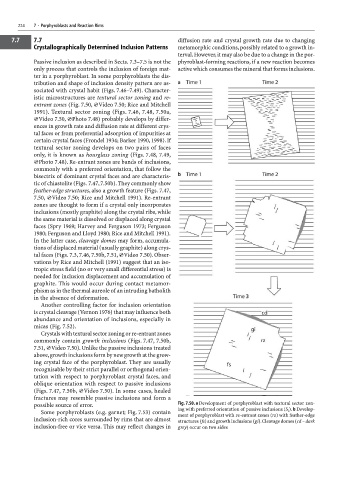
                   sociated with crystal habit (Figs. 7.46–7.49). Character-
                   istic microstructures are textural sector zoning and re-
                   entrant zones (Fig. 7.50, ×Video 7.50; Rice and Mitchell
                   1991). Textural sector zoning (Figs. 7.46, 7.48, 7.50a,
                   ×Video 7.50, ×Photo 7.48) probably develops by differ-
                   ences in growth rate and diffusion rate at different crys-
                   tal faces or from preferential adsorption of impurities at
                   certain crystal faces (Frondel 1934; Barker 1990, 1998). If
                   textural sector zoning develops on two pairs of faces
                   only, it is known as hourglass zoning (Figs. 7.48, 7.49,
                   ×Photo 7.48). Re-entrant zones are bands of inclusions,
                   commonly with a preferred orientation, that follow the
                   bisectrix of dominant crystal faces and are characteris-
                   tic of chiastolite (Figs. 7.47, 7.50b). They commonly show
                   feather-edge structures, also a growth feature (Figs. 7.47,
                   7.50, ×Video 7.50; Rice and Mitchell 1991). Re-entrant
                   zones are thought to form if a crystal only incorporates
                   inclusions (mostly graphite) along the crystal ribs, while
                   the same material is dissolved or displaced along crystal
                   faces (Spry 1969; Harvey and Ferguson 1973; Ferguson
                   1980; Ferguson and Lloyd 1980; Rice and Mitchell 1991).
                   In the latter case, cleavage domes may form, accumula-
                   tions of displaced material (usually graphite) along crys-
                   tal faces (Figs. 7.3, 7.46, 7.50b, 7.51, ×Video 7.50). Obser-
                   vations by Rice and Mitchell (1991) suggest that an iso-
                   tropic stress field (no or very small differential stress) is
                   needed for inclusion displacement and accumulation of
                   graphite. This would occur during contact metamor-
                   phism as in the thermal aureole of an intruding batholith
                   in the absence of deformation.
                     Another controlling factor for inclusion orientation
                   is crystal cleavage (Vernon 1976) that may influence both
                   abundance and orientation of inclusions, especially in
                   micas (Fig. 7.52).
                     Crystals with textural sector zoning or re-entrant zones
                   commonly contain growth inclusions (Figs. 7.47, 7.50b,
                   7.51, ×Video 7.50). Unlike the passive inclusions treated
                   above, growth inclusions form by new growth at the grow-
                   ing crystal face of the porphyroblast. They are usually
                   recognisable by their strict parallel or orthogonal orien-
                   tation with respect to porphyroblast crystal faces, and
                   oblique orientation with respect to passive inclusions
                   (Figs. 7.47, 7.50b, ×Video 7.50). In some cases, healed
                   fractures may resemble passive inclusions and form a
                   possible source of error.                    Fig. 7.50. a Development of porphyroblast with textural sector zon-
                     Some porphyroblasts (e.g. garnet; Fig. 7.53) contain  ing with preferred orientation of passive inclusions (S ). b Develop-
                                                                                                    i
                                                                ment of porphyroblast with re-entrant zones (rz) with feather-edge
                   inclusion-rich cores surrounded by rims that are almost  structures (fs) and growth inclusions (gi). Cleavage domes (cd – dark
                   inclusion-free or vice versa. This may reflect changes in  grey) occur on two sides

