


Page 236 - Microtectonics
P. 236
226   7  ·  Porphyroblasts and Reaction Rims


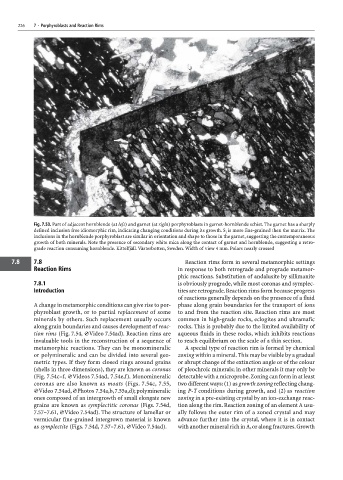
                   Fig. 7.53. Part of adjacent hornblende (at left) and garnet (at right) porphyroblasts in garnet-hornblende schist. The garnet has a sharply
                   defined inclusion free idiomorphic rim, indicating changing conditions during its growth. S  is more fine-grained then the matrix. The
                                                                                i
                   inclusions in the hornblende porphyroblast are similar in orientation and shape to those in the garnet, suggesting the contemporaneous
                   growth of both minerals. Note the presence of secondary white mica along the contact of garnet and hornblende, suggesting a retro-
                   grade reaction consuming hornblende. Kittelfjäll. Västerbotten, Sweden. Width of view 4 mm. Polars nearly crossed
           7.8     7.8                                             Reaction rims form in several metamorphic settings
                   Reaction Rims                                in response to both retrograde and prograde metamor-
                                                                phic reactions. Substitution of andalusite by sillimanite
                   7.8.1                                        is obviously prograde, while most coronas and symplec-
                   Introduction                                 tites are retrograde. Reaction rims form because progress
                                                                of reactions generally depends on the presence of a fluid
                   A change in metamorphic conditions can give rise to por-  phase along grain boundaries for the transport of ions
                   phyroblast growth, or to partial replacement of some  to and from the reaction site. Reaction rims are most
                   minerals by others. Such replacement usually occurs  common in high-grade rocks, eclogites and ultramafic
                   along grain boundaries and causes development of reac-  rocks. This is probably due to the limited availability of
                   tion rims (Fig. 7.54, ×Video 7.54ad). Reaction rims are  aqueous fluids in these rocks, which inhibits reactions
                   invaluable tools in the reconstruction of a sequence of  to reach equilibrium on the scale of a thin section.
                   metamorphic reactions. They can be monomineralic  A special type of reaction rim is formed by chemical
                   or polymineralic and can be divided into several geo-  zoning within a mineral. This may be visible by a gradual
                   metric types. If they form closed rings around grains  or abrupt change of the extinction angle or of the colour
                   (shells in three dimensions), they are known as coronas  of pleochroic minerals; in other minerals it may only be
                   (Fig. 7.54c–f, ×Videos 7.54ad, 7.54e,f). Monomineralic  detectable with a microprobe. Zoning can form in at least
                   coronas are also known as  moats (Figs. 7.54c, 7.55,  two different ways: (1) as growth zoning reflecting chang-
                   ×Video 7.54ad, ×Photos 7.54a,b, 7.55a,d); polymineralic  ing P-T conditions during growth, and (2) as reaction
                   ones composed of an intergrowth of small elongate new  zoning in a pre-existing crystal by an ion-exchange reac-
                   grains are known as symplectitic coronas (Figs. 7.54d,  tion along the rim. Reaction zoning of an element A usu-
                   7.57–7.61, ×Video 7.54ad). The structure of lamellar or  ally follows the outer rim of a zoned crystal and may
                   vermicular fine-grained intergrown material is known  advance further into the crystal, where it is in contact
                   as symplectite (Figs. 7.54d, 7.57–7.61, ×Video 7.54ad).  with another mineral rich in A, or along fractures. Growth

