


Page 237 - Microtectonics
P. 237
7.8  ·  Reaction Rims  227
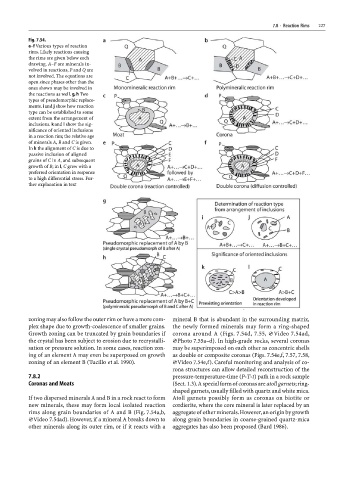
                 Fig. 7.54.
                 a–f Various types of reaction
                 rims. Likely reactions causing
                 the rims are given below each
                 drawing. A–F are minerals in-
                 volved in reactions, P and Q are
                 not involved. The equations are
                 open since phases other than the
                 ones shown may be involved in
                 the reactions as well. g, h Two
                 types of pseudomorphic replace-
                 ments. i and j show how reaction
                 type can be established to some
                 extent from the arrangement of
                 inclusions. k and l show the sig-
                 nificance of oriented inclusions
                 in a reaction rim; the relative age
                 of minerals A, B and C is given.
                 In k the alignment of C is due to
                 passive inclusion of aligned
                 grains of C in A, and subsequent
                 growth of B; in l, C grew with a
                 preferred orientation in response
                 to a high differential stress. Fur-
                 ther explanation in text


                 zoning may also follow the outer rim or have a more com-  mineral B that is abundant in the surrounding matrix,
                 plex shape due to growth-coalescence of smaller grains.  the newly formed minerals may form a ring-shaped
                 Growth zoning can be truncated by grain boundaries if  corona around A (Figs. 7.54d, 7.55, ×Video 7.54ad,
                 the crystal has been subject to erosion due to recrystalli-  ×Photo 7.55a–d). In high-grade rocks, several coronas
                 sation or pressure solution. In some cases, reaction zon-  may be superimposed on each other as concentric shells
                 ing of an element A may even be superposed on growth  as double or composite coronas (Figs. 7.54e,f, 7.57, 7.58,
                 zoning of an element B (Tucillo et al. 1990).  ×Video 7.54e,f). Careful monitoring and analysis of co-
                                                               rona structures can allow detailed reconstruction of the
                 7.8.2                                         pressure-temperature-time (P-T-t) path in a rock sample
                 Coronas and Moats                             (Sect. 1.3). A special form of coronas are atoll garnets; ring-
                                                               shaped garnets, usually filled with quartz and white mica.
                 If two dispersed minerals A and B in a rock react to form  Atoll garnets possibly form as coronas on biotite or
                 new minerals, these may form local isolated reaction  cordierite, where the core mineral is later replaced by an
                 rims along grain boundaries of A and B (Fig. 7.54a,b,  aggregate of other minerals. However, an origin by growth
                 ×Video 7.54ad). However, if a mineral A breaks down to  along grain boundaries in coarse-grained quartz-mica
                 other minerals along its outer rim, or if it reacts with a  aggregates has also been proposed (Bard 1986).

