


Page 241 - Microtectonics
P. 241
7.8  ·  Reaction Rims  231
                 7.8.3                                         grates into one of the grains and leaves a symplectite of
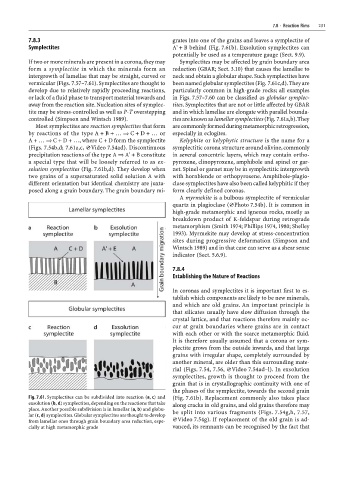
                 Symplectites                                  A' + B behind (Fig. 7.61b). Exsolution symplectites can
                                                               potentially be used as a temperature gauge (Sect. 9.9).
                 If two or more minerals are present in a corona, they may  Symplectites may be affected by grain boundary area
                 form a  symplectite  in which the minerals form an  reduction (GBAR; Sect. 3.10) that causes the lamellae to
                 intergrowth of lamellae that may be straight, curved or  neck and obtain a globular shape. Such symplectites have
                 vermicular (Figs. 7.57–7.61). Symplectites are thought to  been named globular symplectites (Fig. 7.61c,d). They are
                 develop due to relatively rapidly proceeding reactions,  particularly common in high-grade rocks; all examples
                 or lack of a fluid phase to transport material towards and  in Figs. 7.57–7.60 can be classified as globular symplec-
                 away from the reaction site. Nucleation sites of symplec-  tites. Symplectites that are not or little affected by GBAR
                 tite may be stress-controlled as well as P-T overstepping  and in which lamellae are elongate with parallel bounda-
                 controlled (Simpson and Wintsch 1989).        ries are known as lamellar symplectites (Fig. 7.61a,b). They
                   Most symplectites are reaction symplectites that form  are commonly formed during metamorphic retrogression,
                 by reactions of the type A+B+… ⇒ C+D+ … or    especially in eclogites.
                 A+… ⇒ C+D+ …, where C+D form the symplectite    Kelyphite or kelyphytic structure is the name for a
                 (Figs. 7.54b,d; 7.61a,c, ×Video 7.54ad). Discontinuous  symplectitic corona structure around olivine, commonly
                 precipitation reactions of the type A ⇒ A' + B constitute  in several concentric layers, which may contain ortho-
                 a special type that will be loosely referred to as ex-  pyroxene, clinopyroxene, amphibole and spinel or gar-
                 solution symplectites (Fig. 7.61b,d). They develop when  net. Spinel or garnet may be in symplectitic intergrowth
                 two grains of a supersaturated solid solution A with  with hornblende or orthopyroxene. Amphibole-plagio-
                 different orientation but identical chemistry are juxta-  clase symplectites have also been called kelyphitic if they
                 posed along a grain boundary. The grain boundary mi-  form clearly defined coronas.
                                                                 A myrmekite is a bulbous symplectite of vermicular
                                                               quartz in plagioclase (×Photo 7.54b). It is common in
                                                               high-grade metamorphic and igneous rocks, mostly as
                                                               breakdown product of K-feldspar during retrograde
                                                               metamorphism (Smith 1974; Phillips 1974, 1980; Shelley
                                                               1993). Myrmekite may develop at stress-concentration
                                                               sites during progressive deformation (Simpson and
                                                               Wintsch 1989) and in that case can serve as a shear sense
                                                               indicator (Sect. 5.6.9).

                                                               7.8.4
                                                               Establishing the Nature of Reactions

                                                               In coronas and symplectites it is important first to es-
                                                               tablish which components are likely to be new minerals,
                                                               and which are old grains. An important principle is
                                                               that silicates usually have slow diffusion through the
                                                               crystal lattice, and that reactions therefore mainly oc-
                                                               cur at grain boundaries where grains are in contact
                                                               with each other or with the scarce metamorphic fluid.
                                                               It is therefore usually assumed that a corona or sym-
                                                               plectite grows from the outside inwards, and that large
                                                               grains with irregular shape, completely surrounded by
                                                               another mineral, are older than this surrounding mate-
                                                               rial (Figs. 7.54, 7.56, ×Video 7.54ad–l). In exsolution
                                                               symplectites, growth is thought to proceed from the
                                                               grain that is in crystallographic continuity with one of
                                                               the phases of the symplectite, towards the second grain
                 Fig. 7.61. Symplectites can be subdivided into reaction (a, c) and  (Fig. 7.61b). Replacement commonly also takes place
                 exsolution (b, d) symplectites, depending on the reactions that take  along cracks in old grains, and old grains therefore may
                 place. Another possible subdivision is in lamellar (a, b) and globu-
                 lar (c, d) symplectites. Globular symplectites are thought to develop  be split into various fragments (Figs. 7.54g,h, 7.57,
                 from lamellar ones through grain boundary area reduction, espe-  ×Video 7.54g). If replacement of the old grain is ad-
                 cially at high metamorphic grade              vanced, its remnants can be recognised by the fact that

