


Page 242 - Microtectonics
P. 242
232   7  ·  Porphyroblasts and Reaction Rims
                   they all have the same lattice orientation (Fig. 7.54g,h),  grows due to increasing length of the diffusion path
                   and by concave-inward boundaries with the new mineral  (Figs. 7.54f, 7.62c). Especially if Al-rich minerals are in-
                   (Fig. 7.54c,g, ×Video 7.54g). If old grains of two miner-  volved, this possibility should be investigated. In all cases,
                   als are not in contact, they are likely to have reacted  interpretations based on geometrical arguments should
                   with each other to form the corona or symplectite  be checked to see if proposed reactions are chemically
                   (Fig. 7.54i). It is important to realise that contacts may  and thermodynamically possible.
                   be missed in thin sections with few observation sites  Reaction rims are interesting sites for geothermo-
                   (Fig. 12.2i). If old grains of two minerals are in contact,  metry and geobarometry since they form under condi-
                   one of them is probably not involved in the reaction  tions other than the original mineral assemblage and
                   (Fig. 7.54j). New grains form either the corona or part  therefore may define different stages along a P-T-t path
                   of a symplectite, or are finely dispersed in the corona.  (Sect. 1.3). However, there are some potential pitfalls;
                   New grains may be aligned, but will lack the identical  old grains and new grains may be strongly zoned, in
                   lattice orientation of old grain fragments. Small grains  which case it may be difficult to decide which composi-
                   in a corona with a weak preferred orientation may  tions should be used for thermo-barometry; careful
                   have grown as new grains in the corona when it was  reconstruction of the growth of the reaction rim struc-
                   subject to a high differential stress (Sect. 4.2.7.7), but  tures is useful in such cases. Moreover, the composition
                   may also be relicts of inclusions in an old grain that  of old grains may have been modified during the reac-
                   has been replaced. This can usually be decided by  tions. This can usually be determined if zoning in old
                   the presence of relicts of the old grain (Fig. 7.54k,l,  grains is carefully monitored by SEM observation or by
                   ×Video 7.54k,l). If double coronas are present (Fig. 7.54e,f),  a fine grid of measurement points over the grain in a
                   it can be more difficult to establish a relative age. It is  microprobe. If zoning is parallel to the edges of the old
                   sometimes assumed that the outer rim is youngest,  grain, it is probably modified during the reaction. If the
                   but there are other possibilities. With changing meta-  zoning is truncated by reaction rims, especially along
                   morphic conditions, reactions may also occur between  cracks, it is probably original. Finally, care should be taken
                   the included old grain and its corona (Fig. 7.62a), between  with the assumption that only old grains and reaction
                   the corona and phases outside (Fig. 7.62b), or between  rims took part in a reaction; reactions may be rather com-
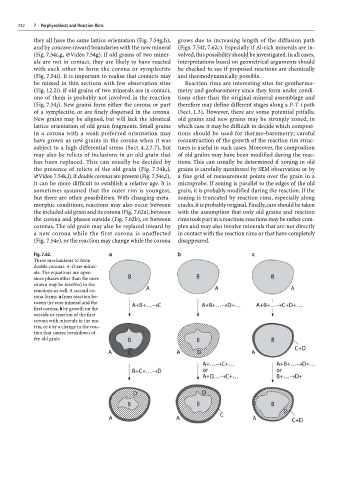
                   coronas. The old grain may also be replaced inward by  plex and may also involve minerals that are not directly
                   a new corona while the first corona is unaffected  in contact with the reaction rims or that have completely
                   (Fig. 7.54e), or the reaction may change while the corona  disappeared.

                   Fig. 7.62.
                   Three mechanisms to form
                   double coronas. A–D are miner-
                   als. The equations are open
                   since phases other than the ones
                   shown may be involved in the
                   reactions as well. A second co-
                   rona forms: a from reaction be-
                   tween the core mineral and the
                   first corona; b by growth on the
                   outside or reaction of the first
                   corona with minerals in the ma-
                   trix, or c by a change in the reac-
                   tion that causes breakdown of
                   the old grain

