


Page 228 - Microtectonics
P. 228
218   7  ·  Porphyroblasts and Reaction Rims

                    Box 7.4  Rotation or non-rotation of spiral-S  porphyroblasts
                                                     i
                    Discussions by several authors have shown that it is difficult to    S i  spirals that can be interpreted as included strain shadows
                    find reliable criteria to determine if spiral-S i  or oblique-S i  por-  are present (Figs. 7.33, 7.37a; Schoneveld 1977, 1979).
                    phyroblasts rotated with respect to kinematic axes of bulk flow    the relative rotation angle of the porphyroblast exceeds 180°.
                    (as in Fig. 7.34b), or not (as in Fig. 7.34c,d,e) (e.g. Bell 1985; Bell    in elongate crystals, the symmetry axis of the S i -spiral in the
                    and Johnson 1989; Bell et al. 1992; Passchier et al. 1992; Johnson  crystals is parallel to the long axis, even in sets of porphyro-
                    1993a,b, 1999). Below we list some criteria that might be of help.  blasts with variable orientation of the long axis (Busa and Gray
                                                                  1992).
                    A rotational interpretation is likely to be correct if
                                                                An interpretation of a spiral- or oblique-S i  inclusion pattern as the
                      the sense of rotation of the porphyroblast is confirmed by  result of matrix deformation around a stable porphyroblast is prob-
                      other sense of shear markers (Busa and Gray 1992; Fig. 7.35).  able if
                      S  spirals in three dimensions have gradually decreasing ampli-
                       i
                      tude towards the rim of the crystal in both directions from the    evidence is present that the foliation in the matrix has passed
                      core of the crystal along the symmetry axis of the spiral (Figs. 7.36b,  trough folding and transposition (e.g. Fig. 7.34e).
                      7.37b; Powell and Treagus 1969, 1970; Busa and Gray 1992).    clear truncation planes are present in S . i
                      included “folds” in S i  have an axial surface trace that is strongly    regional shear sense, determined by independent criteria, is
                      curved (Figs. 7.16, 7.33, 7.37).            not compatible with rotation of the porphyroblasts.


                   2001a,b, 2002; Bell and Chen 2002) have supported the
                   non-rotational model. However, there are indications that
                   the non-rotational model is not generally valid (Passchier
                   et al. 1992; Visser and Mancktelow 1992; Wallis 1992; Gray
                   and Busa 1994; Williams 1994; Chan and Crespi 1999;
                   Williams and Jiang 1999; Kraus and Williams 1998, 2001;
                   Jiang 2001; Jiang and Williams 2004). Johnson (1993a,b)
                   presented a detailed study of spiral shaped inclusion
                   trails in garnets in order to test rotational and non-rota-
                   tional models and concluded that the geometries could
                   be explained with both models. Williams and Jiang (1999)
                   consider the three dimensional configuration of inclu-
                   sion patterns of snowball garnets a distinguishing crite-
                   rion and found that the application of this criterion to
                   all the available data favours the rotational model. How-
                   ever, Johnson (1999b) argues that published sections
                   through snowball garnets may show geometries that
                   Williams and Jiang (1999) consider diagnostic for non-
                   rotation, concluding that the rotational behaviour of
                   spherical porphyroblasts is still poorly understood.
                     Related to the study of the spatial orientation of in-
                   clusion patterns a special technique has been developed
                   to determine so called foliation intersection/inflection
                   axes or ‘FIA’ (Bell et al. 1998; Bell and Hickey 1997, 1999;
                   Hickey and Bell 1999; Bell and Mares 1999; Bell and Chen
                   2002). These may be rotation axes, fold hinges or inter-
                   section lineations between truncating planes. To deter-
                   mine the spatial orientation of FIA two sets of thin sec-
                   tions are required, one with vertical thin sections at vari-
                   ous strikes to determine the trend and another set fan-
                   ning through the horizontal to determine the plunge (see
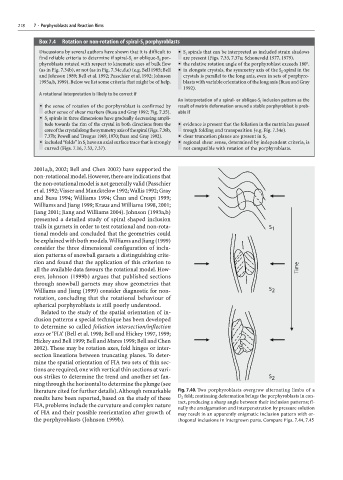
                   literature cited for further details). Although remarkable  Fig. 7.40. Two porphyroblasts overgrow alternating limbs of a
                   results have been reported, based on the study of these  D  fold; continuing deformation brings the porphyroblasts in con-
                                                                  2
                                                                tact, producing a sharp angle between their inclusion patterns; fi-
                   FIA, problems include the curvature and complex nature  nally the amalgamation and interpenetration by pressure solution
                   of FIA and their possible reorientation after growth of  may result in an apparently enigmatic inclusion pattern with or-
                   the porphyroblasts (Johnson 1999b).          thogonal inclusions in intergrown parts. Compare Figs. 7.44, 7.45

