


Page 223 - Microtectonics
P. 223
7.6  ·  Problematic Porphyroblast Microstructures  213


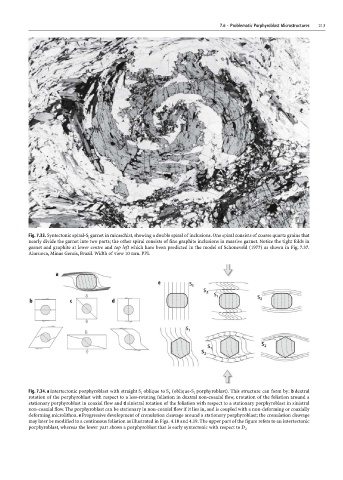
                 Fig. 7.33. Syntectonic spiral-S i  garnet in micaschist, showing a double spiral of inclusions. One spiral consists of coarse quartz grains that
                 nearly divide the garnet into two parts; the other spiral consists of fine graphite inclusions in massive garnet. Notice the tight folds in
                 garnet and graphite at lower centre and top left which have been predicted in the model of Schoneveld (1977) as shown in Fig. 7.37.
                 Aiuruoca, Minas Gerais, Brazil. Width of view 10 mm. PPL


                 Fig. 7.34. a Intertectonic porphyroblast with straight S  oblique to S  (oblique-S  porphyroblast). This structure can form by: b dextral
                                                                      i
                                                     i
                                                              e
                 rotation of the porphyroblast with respect to a less-rotating foliation in dextral non-coaxial flow, c rotation of the foliation around a
                 stationary porphyroblast in coaxial flow and d sinistral rotation of the foliation with respect to a stationary porphyroblast in sinistral
                 non-coaxial flow. The porphyroblast can be stationary in non-coaxial flow if it lies in, and is coupled with a non-deforming or coaxially
                 deforming microlithon. e Progressive development of crenulation cleavage around a stationary porphyroblast; the crenulation cleavage
                 may later be modified to a continuous foliation as illustrated in Figs. 4.18 and 4.19. The upper part of the figure refers to an intertectonic
                 porphyroblast, whereas the lower part shows a porphyroblast that is early syntectonic with respect to D  2

