


Page 325 - Modeling of Chemical Kinetics and Reactor Design
P. 325
Introduction to Reactor Design Fundamentals for Ideal Systems 295
When a substance participates in several reactions at the same time
as exemplified in the above reaction, its net formation rate or disap-
pearance is the algebraic sum of its rates in the elementary reactions.
The following examples review some complex reactions and deter-
mine the concentrations history for a specified period using the Runge-
Kutta fourth order numerical method.
Example 5-4
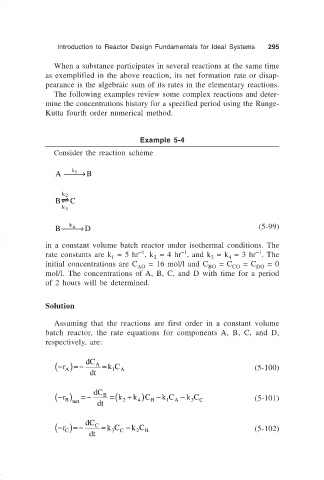
Consider the reaction scheme
A → B
k 1
B[ C
k 2
k 3
B → D (5-99)
k 4
in a constant volume batch reactor under isothermal conditions. The
–1
–1
–1
rate constants are k = 5 hr , k = 4 hr , and k = k = 3 hr . The
1
2
3
4
initial concentrations are C AO = 16 mol/l and C BO = C CO = C DO = 0
mol/l. The concentrations of A, B, C, and D with time for a period
of 2 hours will be determined.
Solution
Assuming that the reactions are first order in a constant volume
batch reactor, the rate equations for components A, B, C, and D,
respectively, are:
− ( r A )=− dC A = kC A (5-100)
1
dt
k
− ( r ) =− dC B =(k + )C − k C − k C (5-101)
B net 2 4 B 1 A 3 C
dt
− ( r C )=− dC C = kC C − k C B (5-102)
2
3
dt

