


Page 320 - Modeling of Chemical Kinetics and Reactor Design
P. 320
290 Modeling of Chemical Kinetics and Reactor Design
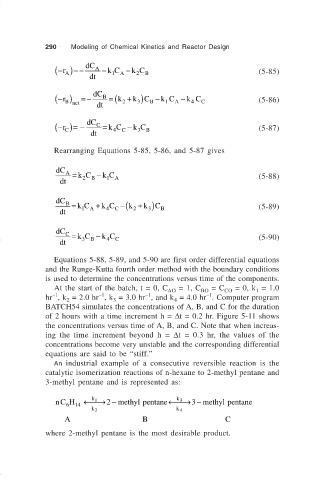
− ( r A )=− dC A = kC A − k C B (5-85)
1
2
dt
k
− ( r ) =− dC B = (k + )C − k C − k C (5-86)
B net 2 3 B 1 A 4 C
dt
− ( r )=− dC C = kC − k C (5-87)
C 4 C 3 B
dt
Rearranging Equations 5-85, 5-86, and 5-87 gives
dC A = kC − k C
dt 2 B 1 A (5-88)
dC
B = kC + k + ) (5-89)
k C
C
4
dt 1 A k C −( 2 3 B
dC
C = kC − k C (5-90)
dt 3 B 4 C
Equations 5-88, 5-89, and 5-90 are first order differential equations
and the Runge-Kutta fourth order method with the boundary conditions
is used to determine the concentrations versus time of the components.
At the start of the batch, t = 0, C AO = 1, C BO = C CO = 0, k = 1.0
1
–1
–1
–1
–1
hr , k = 2.0 hr , k = 3.0 hr , and k = 4.0 hr . Computer program
3
4
2
BATCH54 simulates the concentrations of A, B, and C for the duration
of 2 hours with a time increment h = ∆t = 0.2 hr. Figure 5-11 shows
the concentrations versus time of A, B, and C. Note that when increas-
ing the time increment beyond h = ∆t = 0.3 hr, the values of the
concentrations become very unstable and the corresponding differential
equations are said to be “stiff.”
An industrial example of a consecutive reversible reaction is the
catalytic isomerization reactions of n-hexane to 2-methyl pentane and
3-methyl pentane and is represented as:
k 3
k 1
nC H 14 ←→ 2 − methyl pentane ← → 3− methyl pentane
6
k 2 k 4
B
A C
where 2-methyl pentane is the most desirable product.

