Page 318 - Modeling of Chemical Kinetics and Reactor Design
P. 318
288    Modeling of Chemical Kinetics and Reactor Design


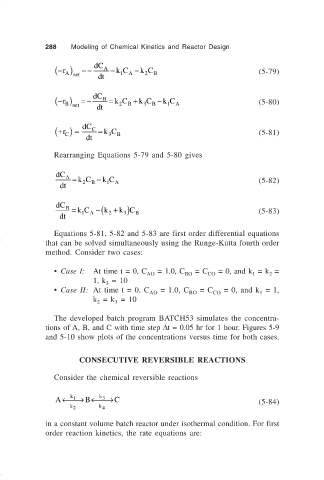
                                 − ( r  )  =−  dC A  = kC  − k C                         (5-79)
                                   A net           1  A  2  B
                                            dt

                                 − ( r  )  =−  dC B  = kC  + k C  − k C                  (5-80)
                                   B net          2  B   3  B   1  A
                                            dt

                                 + ( r  ) =  dC C  = kC                                  (5-81)
                                   C           3  B
                                         dt
                                Rearranging Equations 5-79 and 5-80 gives


                                 dC A  = kC −  k C
                                  dt    2  B   1  A                                      (5-82)

                                 dC
                                   B  =       k + )                                      (5-83)
                                                  k C
                                        1
                                          A
                                  dt   kC −( 2     3   B
                                Equations 5-81, 5-82 and 5-83 are first order differential equations
                              that can be solved simultaneously using the Runge-Kutta fourth order
                              method. Consider two cases:

                                • Case I:  At time t = 0, C AO  = 1.0, C  = C  = 0, and k  = k  =
                                                                                       1
                                                                    BO
                                                                                            2
                                                                           CO
                                           1, k  = 10
                                               3
                                • Case II: At time t = 0, C AO  = 1.0, C BO  = C CO  = 0, and k  = 1,
                                                                                         1
                                           k  = k  = 10
                                            2
                                                 3
                                The developed batch program BATCH53 simulates the concentra-
                              tions of A, B, and C with time step ∆t = 0.05 hr for 1 hour. Figures 5-9
                              and 5-10 show plots of the concentrations versus time for both cases.
                                       CONSECUTIVE REVERSIBLE REACTIONS

                                Consider the chemical reversible reactions

                                 A←→     B← →    C                                       (5-84)
                                    
                                            
                                     k 1
                                             k 3
                                     k 2     k 4
                              in a constant volume batch reactor under isothermal condition. For first
                              order reaction kinetics, the rate equations are:
   313   314   315   316   317   318   319   320   321   322   323