


Page 125 - Modern Derivatization Methods for Separation Sciences
P. 125
Document                                                                                Página 1 de 2


                                                                                                          Page 52


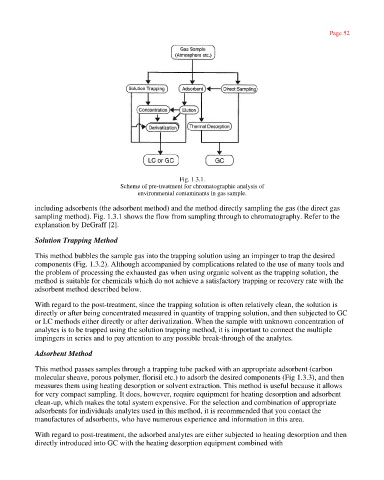
                                                          Fig. 1.3.1.
                                       Scheme of pre-treatment for chromatographic analysis of
                                             environmental contaminants in gas sample.
            including adsorbents (the adsorbent method) and the method directly sampling the gas (the direct gas
            sampling method). Fig. 1.3.1 shows the flow from sampling through to chromatography. Refer to the
            explanation by DeGraff [2].

            Solution Trapping Method

            This method bubbles the sample gas into the trapping solution using an impinger to trap the desired
            components (Fig. 1.3.2). Although accompanied by complications related to the use of many tools and
            the problem of processing the exhausted gas when using organic solvent as the trapping solution, the
            method is suitable for chemicals which do not achieve a satisfactory trapping or recovery rate with the
            adsorbent method described below.


            With regard to the post-treatment, since the trapping solution is often relatively clean, the solution is
            directly or after being concentrated measured in quantity of trapping solution, and then subjected to GC
            or LC methods either directly or after derivatization. When the sample with unknown concentration of
            analytes is to be trapped using the solution trapping method, it is important to connect the multiple
            impingers in series and to pay attention to any possible break-through of the analytes.

            Adsorbent Method

            This method passes samples through a trapping tube packed with an appropriate adsorbent (carbon
            molecular sheave, porous polymer, florisil etc.) to adsorb the desired components (Fig 1.3.3), and then
            measures them using heating desorption or solvent extraction. This method is useful because it allows
            for very compact sampling. It does, however, require equipment for heating desorption and adsorbent
            clean-up, which makes the total system expensive. For the selection and combination of appropriate
            adsorbents for individuals analytes used in this method, it is recommended that you contact the
            manufactures of adsorbents, who have numerous experience and information in this area.


            With regard to post-treatment, the adsorbed analytes are either subjected to heating desorption and then
            directly introduced into GC with the heating desorption equipment combined with


            http://emedia.netlibrary.com/nlreader/nlreader.dll?bookid=17968&filename=Page_52.html     30/09/2003

