


Page 127 - Modern Derivatization Methods for Separation Sciences
P. 127
Document                                                                                Página 1 de 2


                                                                                                          Page 53


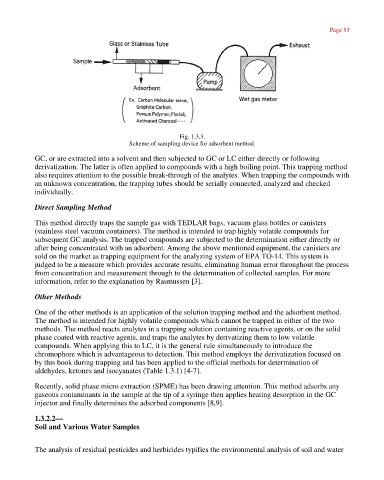
                                                          Fig. 1.3.3.
                                          Scheme of sampling device for adsorbent method.

            GC, or are extracted into a solvent and then subjected to GC or LC either directly or following
            derivatization. The latter is often applied to compounds with a high boiling point. This trapping method
            also requires attention to the possible break-through of the analytes. When trapping the compounds with
            an unknown concentration, the trapping tubes should be serially connected, analyzed and checked
            individually.

            Direct Sampling Method

            This method directly traps the sample gas with TEDLAR bags, vacuum glass bottles or canisters
            (stainless steel vacuum containers). The method is intended to trap highly volatile compounds for
            subsequent GC analysis. The trapped compounds are subjected to the determination either directly or
            after being concentrated with an adsorbent. Among the above mentioned equipment, the canisters are
            sold on the market as trapping equipment for the analyzing system of EPA TO-14. This system is
            judged to be a measure which provides accurate results, eliminating human error throughout the process
            from concentration and measurement through to the determination of collected samples. For more
            information, refer to the explanation by Rasmussen [3].

            Other Methods

            One of the other methods is an application of the solution trapping method and the adsorbent method.
            The method is intended for highly volatile compounds which cannot be trapped in either of the two
            methods. The method reacts analytes in a trapping solution containing reactive agents, or on the solid
            phase coated with reactive agents, and traps the analytes by derivatizing them to low volatile
            compounds. When applying this to LC, it is the general rule simultaneously to introduce the
            chromophore which is advantageous to detection. This method employs the derivatization focused on
            by this book during trapping and has been applied to the official methods for determination of
            aldehydes, ketones and isocyanates (Table 1.3.1) [4-7].

            Recently, solid phase micro extraction (SPME) has been drawing attention. This method adsorbs any
            gaseous contaminants in the sample at the tip of a syringe then applies heating desorption in the GC
            injector and finally determines the adsorbed components [8,9].

            1.3.2.2—
            Soil and Various Water Samples


            The analysis of residual pesticides and herbicides typifies the environmental analysis of soil and water


            http://emedia.netlibrary.com/nlreader/nlreader.dll?bookid=17968&filename=Page_53.html     30/09/2003

