


Page 131 - Modern Derivatization Methods for Separation Sciences
P. 131
Document                                                                                Página 1 de 2


                                                                                                          Page 55

            extraction method: 1) the disposal of a great amount of solvents used causing related health problems;
            2) low operation efficiency; 3) low reproducibility; and 4) low recovery of highpolarity compounds.

            Solid Phase Extraction (SPE)

            This method passes liquid samples through the columns which are packed with silica gel chemically
            bonded with the octadecyl silyl (ODS) group, with active carbon or other packings used as trapping
            agents to trap the analytes. Compounds trapped on packing are extracted into solvent or solution with a
            different polarity from the sample solution, and then concentration and clean-up is carried out. The
            trapping agents can be classified into adsorbents and chemically bonded reversedphase silica gel. The
            former includes active carbon, ion exchange resin, and porous polymer. The latter uses silica gel as a
            base, chemically bonded with ODS or the octyl group. Nowadays many mini-columns using such
            packings are sold in the market. It is advisable to contact the manufacturers for the selection of the
            columns to suit the required use. Regarding post-treatment, the eluent is generally subjected to GC or
            LC either directly, or following concentration or derivatization, except in the case of samples with
            complicated matrices.

            For the determination of residual pesticides and herbicides in water samples using chromatography,
            refer to several general remarks referenced in [12-15].

            1.3.3—
            Application

            In the determination of environmental contaminants, the derivatization HPLC is applied to a far fewer
            number of compounds than in other fields. Introduced below are the studies on individual compounds
            which have mainly examined the precolumn derivatization method intended for highly sensitive
            detection.

            1.3.3.1—
            Aldehydes and Ketones in Air


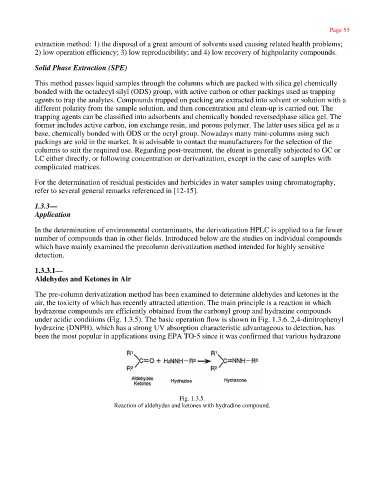
            The pre-column derivatization method has been examined to determine aldehydes and ketones in the
            air, the toxicity of which has recently attracted attention. The main principle is a reaction in which
            hydrazone compounds are efficiently obtained from the carbonyl group and hydrazine compounds
            under acidic conditions (Fig. 1.3.5). The basic operation flow is shown in Fig. 1.3.6. 2,4-dinitrophenyl
            hydrazine (DNPH), which has a strong UV absorption characteristic advantageous to detection, has
            been the most popular in applications using EPA TO-5 since it was confirmed that various hydrazone


                                                          Fig. 1.3.5.
                                     Reaction of aldehydes and ketones with hydradine compound.


            http://emedia.netlibrary.com/nlreader/nlreader.dll?bookid=17968&filename=Page_55.html     30/09/2003

