


Page 133 - Modern Derivatization Methods for Separation Sciences
P. 133
Document                                                                                Página 1 de 2


                                                                                                           Page 56

            derivatives produced from DNPH can be separated by the reverse-phase HPLC method [16]. Recently,
            Cotrim and others [17] reported the optimum separation conditions for eight types of DNPH derivatives
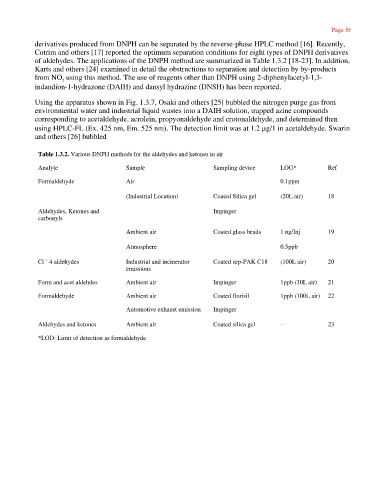
            of aldehydes. The applications of the DNPH method are summarized in Table 1.3.2 [18-23]. In addition,
            Karts and others [24] examined in detail the obstructions to separation and detection by by-products
            from NO  using this method. The use of reagents other than DNPH using 2-diphenylacetyl-1,3-
                     2
            indandion-1-hydrazone (DAIH) and dansyl hydrazine (DNSH) has been reported.
            Using the apparatus shown in Fig. 1.3.7, Osaki and others [25] bubbled the nitrogen purge gas from
            environmental water and industrial liquid wastes into a DAIH solution, trapped azine compounds
            corresponding to acetaldehyde, acrolein, propyonaldehyde and crotonaldehyde, and determined then
            using HPLC-FL (Ex. 425 nm, Em. 525 nm). The detection limit was at 1.2 µg/1 in acetaldehyde. Swarin
            and others [26] bubbled


             Table 1.3.2. Various DNPH methods for the aldehydes and ketones in air
             Analyte                     Sample                      Sampling device      LOG*           Ref

             Formaldehyde                Air                                              0.1ppm

                                         (Industrial Location)       Coated Silica gel    (20L air)      18

             Aldehydes, Ketones and                                  Impinger
             carbonyls
                                         Ambient air                 Coated glass beads   1 ng/Inj       19

                                         Atmosphere                                       0.5ppb

             Cl ˜ 4 aldehydes            Industrial and incinerator   Coated sep-PAK C18  (100L air)     20
                                         emissions
             Form and acet aldehdes      Ambient air                 Impinger             1ppb (30L air)  21

             Formaldehyde                Ambient air                 Coated florisil      1ppb (100L air)  22

                                         Automotive exhaust emission  Impinger

             Aldehydes and ketones       Ambient air                 Coated silica gel    -              23
             *LOD: Limit of detection as formaldehyde


            http://emedia.netlibrary.com/nlreader/nlreader.dll?bookid=17968&filename=Page_56.html     30/09/2003

