


Page 149 - Modern Derivatization Methods for Separation Sciences
P. 149
Document                                                                                Página 2 de 2


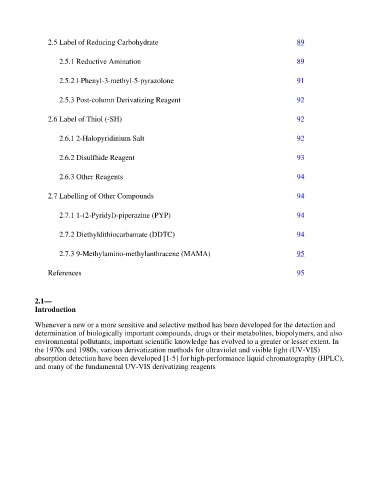
                2.5 Label of Reducing Carbohydrate                                             89

                    2.5.1 Reductive Amination                                                  89


                    2.5.2 l-Phenyl-3-methyl-5-pyrazolone                                       91


                    2.5.3 Post-column Derivatizing Reagent                                     92


                2.6 Label of Thiol (-SH)                                                       92


                    2.6.1 2-Halopyridinium Salt                                                92

                    2.6.2 Disulfhide Reagent                                                   93


                    2.6.3 Other Reagents                                                       94


                2.7 Labelling of Other Compounds                                               94


                    2.7.1 1-(2-Pyridyl)-piperazine (PYP)                                       94


                    2.7.2 Diethyldithiocarbamate (DDTC)                                        94


                    2.7.3 9-Methylamino-methylanthracene (MAMA)                                95

                References                                                                     95


            2.1—
            Introduction

            Whenever a new or a more sensitive and selective method has been developed for the detection and
            determination of biologically important compounds, drugs or their metabolites, biopolymers, and also
            environmental pollutants, important scientific knowledge has evolved to a greater or lesser extent. In
            the 1970s and 1980s, various derivatization methods for ultraviolet and visible light (UV-VIS)
            absorption detection have been developed [1-5] for high-performance liquid chromatography (HPLC),
            and many of the fundamental UV-VIS derivatizing reagents


            http://emedia.netlibrary.com/nlreader/nlreader.dll?bookid=17968&filename=Page_64.html     30/09/2003

