


Page 154 - Modern Derivatization Methods for Separation Sciences
P. 154
Document                                                                                Página 1 de 2


                                                                                                          Page 67

            Na CO  was added and incubated for a further 5 min. After cooling the mixture, NTP-polyamines were
               2   3
            extracted twice with 2 ml of 2-methylbutane. The organic phase was evaporated to dryness. The residue
            was reconstitute with 50 µ1 of MeOH and 10-µ1 aliquots were subjected to PR-HPLC with the
            detection at 242 nm. The detection limits were 5 pmol for putrescine, 10 pmol for spermidine and 25
            pmol for spermine.

            2.2.1.3—
            2,4,6-Trinitrobenzene-1-sulfonic Acid (TNBS) [18]

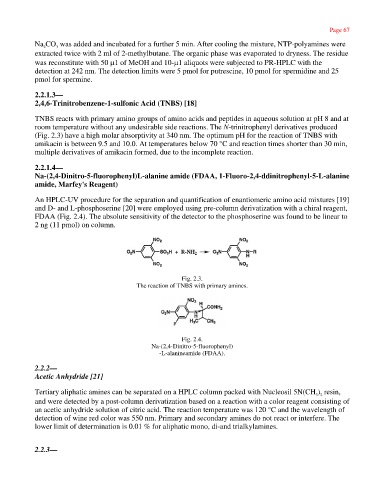
            TNBS reacts with primary amino groups of amino acids and peptides in aqueous solution at pH 8 and at
            room temperature without any undesirable side reactions. The N-trinitrophenyl derivatives produced
            (Fig. 2.3) have a high molar absorptivity at 340 nm. The optimum pH for the reaction of TNBS with
            amikacin is between 9.5 and 10.0. At temperatures below 70 °C and reaction times shorter than 30 min,
            multiple derivatives of amikacin formed, due to the incomplete reaction.

            2.2.1.4—
            Na-(2,4-Dinitro-5-fluorophenyl)L-alanine amide (FDAA, 1-Fluoro-2,4-ddinitrophenyl-5-L-alanine
            amide, Marfey's Reagent)

            An HPLC-UV procedure for the separation and quantification of enantiomeric amino acid mixtures [19]
            and D- and L-phosphoserine [20] were employed using pre-column derivatization with a chiral reagent,
            FDAA (Fig. 2.4). The absolute sensitivity of the detector to the phosphoserine was found to be linear to
            2 ng (11 pmol) on column.


                                                           Fig. 2.3.
                                             The reaction of TNBS with primary amines.


                                                           Fig. 2.4.
                                                 Na-(2,4-Dinitro-5-fluorophenyl)
                                                    -L-alanineamide (FDAA).

            2.2.2—
            Acetic Anhydride [21]

            Tertiary aliphatic amines can be separated on a HPLC column packed with Nucleosil 5N(CH )  resin,
                                                                                                     3 2
            and were detected by a post-column derivatization based on a reaction with a color reagent consisting of
            an acetic anhydride solution of citric acid. The reaction temperature was 120 °C and the wavelength of
            detection of wine red color was 550 nm. Primary and secondary amines do not react or interfere. The
            lower limit of determination is 0.01 % for aliphatic mono, di-and trialkylamines.


            2.2.3—


            http://emedia.netlibrary.com/nlreader/nlreader.dll?bookid=17968&filename=Page_67.html     30/09/2003

