


Page 158 - Modern Derivatization Methods for Separation Sciences
P. 158
Document                                                                                Página 1 de 2


                                                                                                          Page 69

             Table 2.1. HPLC analyses of free amino acids: comparison of four derivatization methods

             Parameter                   PITC          OPA            FMOC-Cl        DNS-Cl

             Limit of sensitivity, pmol S/N =  5.0     0.8            1.0            1.5
             2.5

             Reproducibility(R.S.D.)     2.6-5.5       0.4-2.2        1.9-4.6        1.5-4.1
             Stable adducts              yes           no             yes            yes

             Detection of secondary      yes/yes       no/no          yes/no         yes/yes
             amines/cystine
             Problematic amino acids     Orn, Trp His,   Asp, Trp     His, Trp       His, Asn
                                         (Cys)2
             Effort required             ++            -              +++            +

             PITC: phenyl isothiocyanate, OPA: o-phthalaldehyde, FNOC-Cl: 9-fluorenylmethyl chloroformate (9-
             fluorenylmethoxycarbonyl chloride, DNS-Cl: dansyl chloride. Reproduced with permission from P.
             Fürst. L. Pollack, T.A. Graser, H. Godel and P. Stehle (1990) J. Chromatogr., 499, 557 [32]


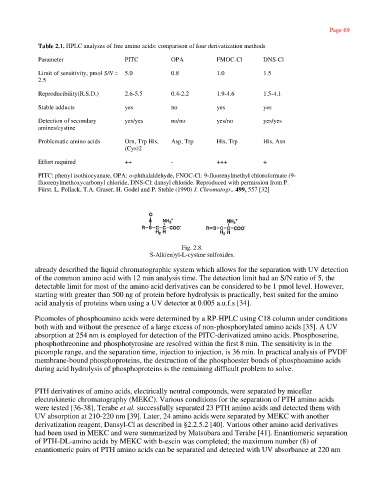
                                                           Fig. 2.8.
                                                 S-Alk(en)yl-L-cystine sulfoxides.

            already described the liquid chromatographic system which allows for the separation with UV detection
            of the common amino acid with 12 min analysis time. The detection limit had an S/N ratio of 5, the
            detectable limit for most of the amino acid derivatives can be considered to be 1 pmol level. However,
            starting with greater than 500 ng of protein before hydrolysis is practically, best suited for the amino
            acid analysis of proteins when using a UV detector at 0.005 a.u.f.s [34].

            Picomoles of phosphoamino acids were determined by a RP-HPLC using C18 column under conditions
            both with and without the presence of a large excess of non-phosphorylated amino acids [35]. A UV
            absorption at 254 nm is employed for detection of the PITC-derivatized amino acids. Phosphoserine,
            phosphothreonine and phosphotyrosine are resolved within the first 8 min. The sensitivity is in the
            picomple range, and the separation time, injection to injection, is 36 min. In practical analysis of PVDF
            membrane-bound phosphoproteins, the destruction of the phosphoester bonds of phosphoamino acids
            during acid hydrolysis of phosphoproteins is the remaining difficult problem to solve.


            PTH derivatives of amino acids, electrically neutral compounds, were separated by micellar
            electrokinetic chromatography (MEKC). Various conditions for the separation of PTH amino acids
            were tested [36-38], Terabe et al. successfully separated 23 PTH amino acids and detected them with
            UV absorption at 210-220 nm [39]. Later, 24 amino acids were separated by MEKC with another
            derivatization reagent, Dansyl-Cl as described in §2.2.5.2 [40]. Various other amino acid derivatives
            had been used in MEKC and were summarized by Matsubara and Terabe [41]. Enantiomeric separation
            of PTH-DL-amino acids by MEKC with b-escin was completed; the maximum number (8) of
            enantiomeric pairs of PTH amino acids can be separated and detected with UV absorbance at 220 nm


            http://emedia.netlibrary.com/nlreader/nlreader.dll?bookid=17968&filename=Page_69.html     30/09/2003

