


Page 162 - Modern Derivatization Methods for Separation Sciences
P. 162
Document                                                                                Página 1 de 2


                                                                                                          Page 71


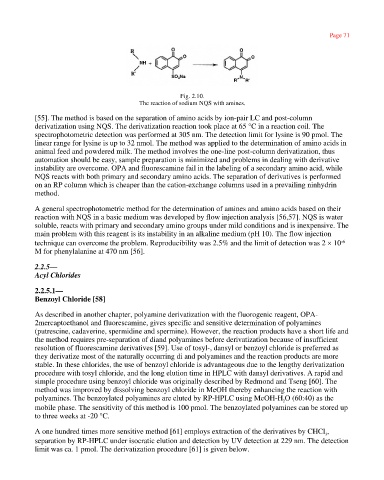
                                                          Fig. 2.10.
                                             The reaction of sodium NQS with amines.
            [55]. The method is based on the separation of amino acids by ion-pair LC and post-column
            derivatization using NQS. The derivatization reaction took place at 65 °C in a reaction coil. The
            spectrophotometric detection was performed at 305 nm. The detection limit for lysine is 90 pmol. The
            linear range for lysine is up to 32 nmol. The method was applied to the determination of amino acids in
            animal feed and powdered milk. The method involves the one-line post-column derivatization, thus
            automation should be easy, sample preparation is minimized and problems in dealing with derivative
            instability are overcome. OPA and fluorescamine fail in the labeling of a secondary amino acid, while
            NQS reacts with both primary and secondary amino acids. The separation of derivatives is performed
            on an RP column which is cheaper than the cation-exchange columns used in a prevailing ninhydrin
            method.
            A general spectrophotometric method for the determination of amines and amino acids based on their
            reaction with NQS in a basic medium was developed by flow injection analysis [56,57]. NQS is water
            soluble, reacts with primary and secondary amino groups under mild conditions and is inexpensive. The
            main problem with this reagent is its instability in an alkaline medium (pH 10). The flow injection
            technique can overcome the problem. Reproducibility was 2.5% and the limit of detection was 2 × 10
                                                                                                              -6
            M for phenylalanine at 470 nm [56].

            2.2.5—
            Acyl Chlorides

            2.2.5.1—
            Benzoyl Chloride [58]


            As described in another chapter, polyamine derivatization with the fluorogenic reagent, OPA-
            2mercaptoethanol and fluorescamine, gives specific and sensitive determination of polyamines
            (putrescine, cadaverine, spermidine and spermine). However, the reaction products have a short life and
            the method requires pre-separation of diand polyamines before derivatization because of insufficient
            resolution of fluorescamine derivatives [59]. Use of tosyl-, dansyl or benzoyl chloride is preferred as
            they derivatize most of the naturally occurring di and polyamines and the reaction products are more
            stable. In these chlorides, the use of benzoyl chloride is advantageous due to the lengthy derivatization
            procedure with tosyl chloride, and the long elution time in HPLC with dansyl derivatives. A rapid and
            simple procedure using benzoyl chloride was originally described by Redmond and Tseng [60]. The
            method was improved by dissolving benzoyl chloride in MeOH thereby enhancing the reaction with
            polyamines. The benzoylated polyamines are eluted by RP-HPLC using MeOH-H O (60:40) as the
                                                                                           2
            mobile phase. The sensitivity of this method is 100 pmol. The benzoylated polyamines can be stored up
            to three weeks at -20 °C.

            A one hundred times more sensitive method [61] employs extraction of the derivatives by CHCl ,
                                                                                                         3
            separation by RP-HPLC under isocratic elution and detection by UV detection at 229 nm. The detection
            limit was ca. 1 pmol. The derivatization procedure [61] is given below.


            http://emedia.netlibrary.com/nlreader/nlreader.dll?bookid=17968&filename=Page_71.html     30/09/2003

