


Page 164 - Modern Derivatization Methods for Separation Sciences
P. 164
Document                                                                                Página 1 de 2


                                                                                                          Page 72

            of the 0.3 M perchloric acid extract containing a known amount of 1,6-hexanediamine (IS). Tubes were
            closed with caps with PTFE-coated rubber closure, and the contents were mixed vigorously and
            incubated for 30 min at room temperature under gentle rotation. The resulting solution was extracted
            with 2 ml of CHCl . After centrifugation the CHCl  layer was removed, washed with 2 ml of water,
                              3
                                                             3
            centrifuged and transferred to another tube. The solvent was evaporated under a stream of air and the
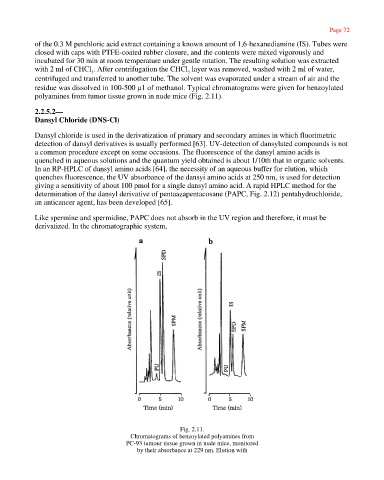
            residue was dissolved in 100-500 µ1 of methanol. Typical chromatograms were given for benzoylated
            polyamines from tumor tissue grown in nude mice (Fig. 2.11).

            2.2.5.2—
            Dansyl Chloride (DNS-Cl)

            Dansyl chloride is used in the derivatization of primary and secondary amines in which fluorimetric
            detection of dansyl derivatives is usually performed [63]. UV-detection of dansylated compounds is not
            a common procedure except on some occasions. The fluorescence of the dansyl amino acids is
            quenched in aqueous solutions and the quantum yield obtained is about 1/10th that in organic solvents.
            In an RP-HPLC of dansyl amino acids [64], the necessity of an aqueous buffer for elution, which
            quenches fluorescence, the UV absorbance of the dansyi amino acids at 250 nm, is used for detection
            giving a sensitivity of about 100 pmol for a single dansyl amino acid. A rapid HPLC method for the
            determination of the dansyl derivative of pentaazapentacosane (PAPC, Fig. 2.12) pentahydrochloride,
            an anticancer agent, has been developed [65].

            Like spermine and spermidine, PAPC does not absorb in the UV region and therefore, it must be
            derivatized. In the chromatographic system,


                                                          Fig. 2.11.
                                           Chromatograms of benzoylated polyamines from
                                         PC-93 tumour tissue grown in nude mice, monitored
                                             by their absorbance at 229 nm. Elution with


            http://emedia.netlibrary.com/nlreader/nlreader.dll?bookid=17968&filename=Page_72.html     30/09/2003

