


Page 168 - Modern Derivatization Methods for Separation Sciences
P. 168
Document                                                                                Página 1 de 2


                                                                                                          Page 74


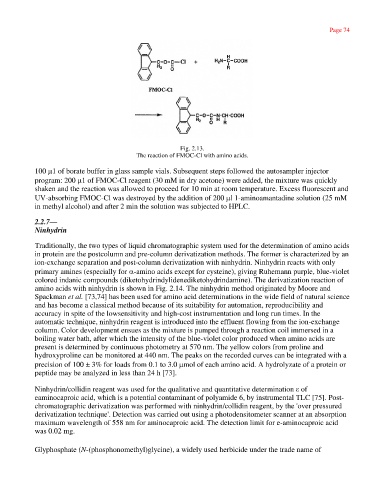
                                                          Fig. 2.13.
                                            The reaction of FMOC-Cl with amino acids.

            100 µ1 of borate buffer in glass sample vials. Subsequent steps followed the autosampler injector
            program: 200 µ1 of FMOC-Cl reagent (30 mM in dry acetone) were added, the mixture was quickly
            shaken and the reaction was allowed to proceed for 10 min at room temperature. Excess fluorescent and
            UV-absorbing FMOC-Cl was destroyed by the addition of 200 µl 1-aminoamantadine solution (25 mM
            in methyl alcohol) and after 2 min the solution was subjected to HPLC.

            2.2.7—
            Ninhydrin

            Traditionally, the two types of liquid chromatographic system used for the determination of amino acids
            in protein are the postcolumn and pre-column derivatization methods. The former is characterized by an
            ion-exchange separation and post-column derivatization with ninhydrin. Ninhydrin reacts with only
            primary amines (especially for α-amino acids except for cysteine), giving Ruhemann purple, blue-violet
            colored indanic compounds (diketohydrindylidenediketohydrindamine). The derivatization reaction of
            amino acids with ninhydrin is shown in Fig. 2.14. The ninhydrin method originated by Moore and
            Spackman et al. [73,74] has been used for amino acid determinations in the wide field of natural science
            and has become a classical method because of its suitability for automation, reproducibility and
            accuracy in spite of the lowsensitivity and high-cost instrumentation and long run times. In the
            automatic technique, ninhydrin reagent is introduced into the effluent flowing from the ion-exchange
            column. Color development ensues as the mixture is pumped through a reaction coil immersed in a
            boiling water bath, after which the intensity of the blue-violet color produced when amino acids are
            present is determined by continuous photometry at 570 nm. The yellow colors from proline and
            hydroxyproline can be monitored at 440 nm. The peaks on the recorded curves can be integrated with a
            precision of 100 ± 3% for loads from 0.1 to 3.0 µmol of each amino acid. A hydrolyzate of a protein or
            peptide may be analyzed in less than 24 h [73].

            Ninhydrin/collidin reagent was used for the qualitative and quantitative determination ε of
            eaminocaproic acid, which is a potential contaminant of polyamide 6, by instrumental TLC [75]. Post-
            chromatographic derivatization was performed with ninhydrin/collidin reagent, by the 'over pressured
            derivatization technique'. Detection was carried out using a photodensitometer scanner at an absorption
            maximum wavelength of 558 nm for aminocaproic acid. The detection limit for e-aminocaproic acid
            was 0.02 mg.

            Glyphosphate (N-(phosphonomethyl)glycine), a widely used herbicide under the trade name of


            http://emedia.netlibrary.com/nlreader/nlreader.dll?bookid=17968&filename=Page_74.html     30/09/2003

