


Page 172 - Modern Derivatization Methods for Separation Sciences
P. 172
Document                                                                                Página 1 de 2


                                                                                                          Page 76

            sodium borate buffer (pH 9.0) (1 ml) containing 0.02% of sodium azide was added 0.8 µ1 of DEMM.
            The reaction was carried out at 50 °C for 50 min with vigorous shaking. The resulting mixture was
            cooled to room temperature and 15 µl were subjected to an HPLC.

            2.2.9—
            6-Aminoquinolyl-N-hydroxyuccinimidyl Carbamate (AQC)

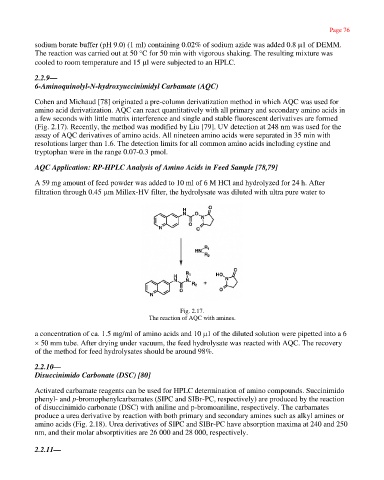
            Cohen and Michaud [78] originated a pre-column derivatization method in which AQC was used for
            amino acid derivatization. AQC can react quantitatively with all primary and secondary amino acids in
            a few seconds with little matrix interference and single and stable fluorescent derivatives are formed
            (Fig. 2.17). Recently, the method was modified by Liu [79]. UV detection at 248 nm was used for the
            assay of AQC derivatives of amino acids. All nineteen amino acids were separated in 35 min with
            resolutions larger than 1.6. The detection limits for all common amino acids including cystine and
            tryptophan were in the range 0.07-0.3 pmol.

            AQC Application: RP-HPLC Analysis of Amino Acids in Feed Sample [78,79]

            A 59 mg amount of feed powder was added to 10 ml of 6 M HCl and hydrolyzed for 24 h. After
            filtration through 0.45 µm Millex-HV filter, the hydrolysate was diluted with ultra pure water to


                                                          Fig. 2.17.
                                                The reaction of AQC with amines.

            a concentration of ca. 1.5 mg/ml of amino acids and 10 µ1 of the diluted solution were pipetted into a 6
            × 50 mm tube. After drying under vacuum, the feed hydrolysate was reacted with AQC. The recovery
            of the method for feed hydrolysates should be around 98%.

            2.2.10—
            Disuccinimido Carbonate (DSC) [80]

            Activated carbamate reagents can be used for HPLC determination of amino compounds. Succinimido
            phenyl- and p-bromophenylcarbamates (SIPC and SIBr-PC, respectively) are produced by the reaction
            of disuccinimido carbonate (DSC) with aniline and p-bromoaniline, respectively. The carbamates
            produce a urea derivative by reaction with both primary and secondary amines such as alkyl amines or
            amino acids (Fig. 2.18). Urea derivatives of SIPC and SIBr-PC have absorption maxima at 240 and 250
            nm, and their molar absorptivities are 26 000 and 28 000, respectively.

            2.2.11—


            http://emedia.netlibrary.com/nlreader/nlreader.dll?bookid=17968&filename=Page_76.html     30/09/2003

