


Page 175 - Modern Derivatization Methods for Separation Sciences
P. 175
Document                                                                                Página 1 de 2


                                                                                                          Page 78


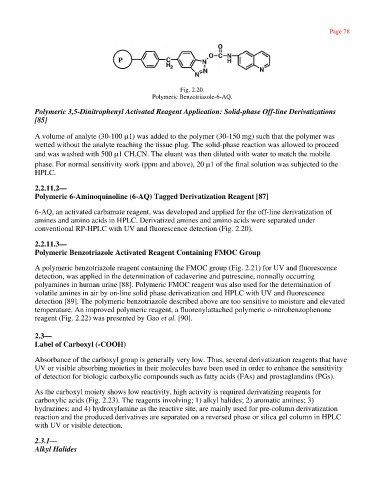
                                                          Fig. 2.20.
                                                 Polymeric Benzotriazole-6-AQ.

            Polymeric 3,5-Dinitrophenyl Activated Reagent Application: Solid-phase Off-line Derivatizations
            [85]

            A volume of analyte (30-100 µ1) was added to the polymer (30-150 mg) such that the polymer was
            wetted without the analyte reaching the tissue plug. The solid-phase reaction was allowed to proceed
            and was washed with 500 µ1 CH CN. The eluant was then diluted with water to match the mobile
                                            3
            phase. For normal sensitivity work (ppm and above), 20 µ1 of the final solution was subjected to the
            HPLC.

            2.2.11.2—
            Polymeric 6-Aminoquinoline (6-AQ) Tagged Derivatization Reagent [87]

            6-AQ, an activated carbamate reagent, was developed and applied for the off-line derivatization of
            amines and amino acids in HPLC. Derivatized amines and amino acids were separated under
            conventional RP-HPLC with UV and fluorescence detection (Fig. 2.20).


            2.2.11.3—
            Polymeric Benzotriazole Activated Reagent Containing FMOC Group

            A polymeric benzotriazole reagent containing the FMOC group (Fig. 2.21) for UV and fluorescence
            detection, was applied in the determination of cadaverine and putrescine, normally occurring
            polyamines in human urine [88]. Polymeric FMOC reagent was also used for the determination of
            volatile amines in air by on-line solid phase derivatization and HPLC with UV and fluorescence
            detection [89]. The polymeric benzotriazole described above are too sensitive to moisture and elevated
            temperature. An improved polymeric reagent, a fluorenylattached polymeric o-nitrobenzophenone
            reagent (Fig. 2.22) was presented by Gao et al. [90].


            2.3—
            Label of Carboxyl (-COOH)
            Absorbance of the carboxyl group is generally very low. Thus, several derivatization reagents that have
            UV or visible absorbing moieties in their molecules have been used in order to enhance the sensitivity
            of detection for biologic carboxylic compounds such as fatty acids (FAs) and prostaglandins (PGs).

            As the carboxyl moiety shows low reactivity, high activity is required derivatizing reagents for
            carboxylic acids (Fig. 2.23). The reagents involving; 1) alkyl halides; 2) aromatic amines; 3)
            hydrazines; and 4) hydroxylamine as the reactive site, are mainly used for pre-column derivatization
            reaction and the produced derivatives are separated on a reversed phase or silica gel column in HPLC
            with UV or visible detection.

            2.3.1—
            Alkyl Halides


            http://emedia.netlibrary.com/nlreader/nlreader.dll?bookid=17968&filename=Page_78.html     30/09/2003

