


Page 180 - Modern Derivatization Methods for Separation Sciences
P. 180
Document                                                                                Página 1 de 2


                                                                                                          Page 81


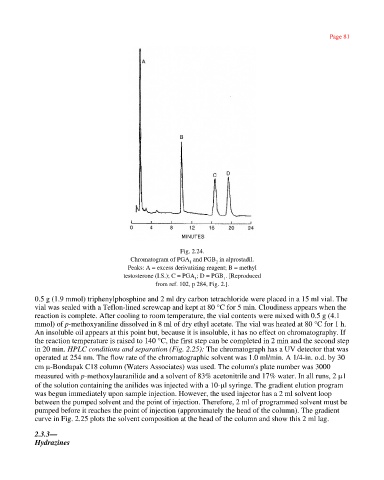
                                                          Fig. 2.24.
                                           Chromatogram of PGA  and PGB  in alprostadil.
                                                                      2
                                                             1
                                          Peaks: A = excess derivatizing reagent; B = methyl
                                        testosterone (I.S.); C = PGA ; D = PGB . [Reproduced
                                                                        1
                                                               1
                                                  from ref. 102, p 284, Fig. 2.].
            0.5 g (1.9 mmol) triphenylphosphine and 2 ml dry carbon tetrachloride were placed in a 15 ml vial. The
            vial was sealed with a Teflon-lined screwcap and kept at 80 °C for 5 min. Cloudiness appears when the
            reaction is complete. After cooling to room temperature, the vial contents were mixed with 0.5 g (4.1
            mmol) of p-methoxyaniline dissolved in 8 ml of dry ethyl acetate. The vial was heated at 80 °C for 1 h.
            An insoluble oil appears at this point but, because it is insoluble, it has no effect on chromatography. If
            the reaction temperature is raised to 140 °C, the first step can be completed in 2 min and the second step
            in 20 min. HPLC conditions and separation (Fig. 2.25): The chromatograph has a UV detector that was
            operated at 254 nm. The flow rate of the chromatographic solvent was 1.0 ml/min. A 1/4-in. o.d. by 30
            cm µ-Bondapak C18 column (Waters Associates) was used. The column's plate number was 3000
            measured with p-methoxylauranilide and a solvent of 83% acetonitrile and 17% water. In all runs, 2 µ1
            of the solution containing the anilides was injected with a 10-µl syringe. The gradient elution program
            was begun immediately upon sample injection. However, the used injector has a 2 ml solvent loop
            between the pumped solvent and the point of injection. Therefore, 2 ml of programmed solvent must be
            pumped before it reaches the point of injection (approximately the head of the column). The gradient
            curve in Fig. 2.25 plots the solvent composition at the head of the column and show this 2 ml lag.

            2.3.3—
            Hydrazines


            http://emedia.netlibrary.com/nlreader/nlreader.dll?bookid=17968&filename=Page_81.html     30/09/2003

