


Page 177 - Modern Derivatization Methods for Separation Sciences
P. 177
Document                                                                                Página 1 de 2


                                                                                                          Page 79


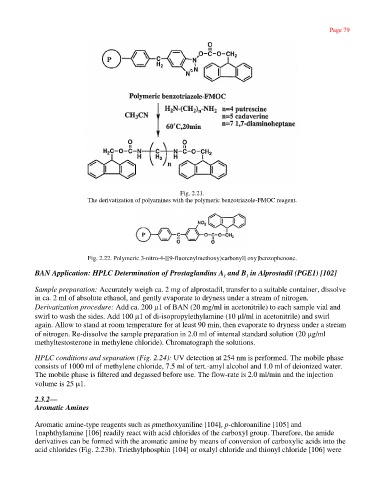
                                                          Fig. 2.21.
                             The derivatization of polyamines with the polymeric benzotriazole-FMOC reagent.


                             Fig. 2.22. Polymeric 3-nitro-4-[[9-fluorenylmethoxy)carbonyl] oxy]benzophenone.

            BAN Application: HPLC Determination of Prostaglandins A  and B  in Alprostadil (PGE1) [102]
                                                                        1      1

            Sample preparation: Accurately weigh ca. 2 mg of alprostadil, transfer to a suitable container, dissolve
            in ca. 2 ml of absolute ethanol, and gently evaporate to dryness under a stream of nitrogen.
            Derivatization procedure: Add ca. 200 µ1 of BAN (20 mg/ml in acetonitrile) to each sample vial and
            swirl to wash the sides. Add 100 µ1 of di-isopropylethylamine (10 µl/ml in acetonitrile) and swirl
            again. Allow to stand at room temperature for at least 90 min, then evaporate to dryness under a stream
            of nitrogen. Re-dissolve the sample preparation in 2.0 ml of internal standard solution (20 µg/ml
            methyltestosterone in methylene chloride). Chromatograph the solutions.

            HPLC conditions and separation (Fig. 2.24): UV detection at 254 nm is performed. The mobile phase
            consists of 1000 ml of methylene chloride, 7.5 ml of tert.-amyl alcohol and 1.0 ml of deionized water.
            The mobile phase is filtered and degassed before use. The flow-rate is 2.0 ml/min and the injection
            volume is 25 µ1.

            2.3.2—
            Aromatic Amines

            Aromatic amine-type reagents such as pmethoxyaniline [104], p-chloroaniline [105] and
            1naphthylamine [106] readily react with acid chlorides of the carboxyl group. Therefore, the amide
            derivatives can be formed with the aromatic amine by means of conversion of carboxylic acids into the
            acid chlorides (Fig. 2.23b). Triethylphosphin [104] or oxalyl chloride and thionyl chloride [106] were


            http://emedia.netlibrary.com/nlreader/nlreader.dll?bookid=17968&filename=Page_79.html     30/09/2003

