


Page 182 - Modern Derivatization Methods for Separation Sciences
P. 182
Document                                                                                Página 1 de 2


                                                                                                          Page 82


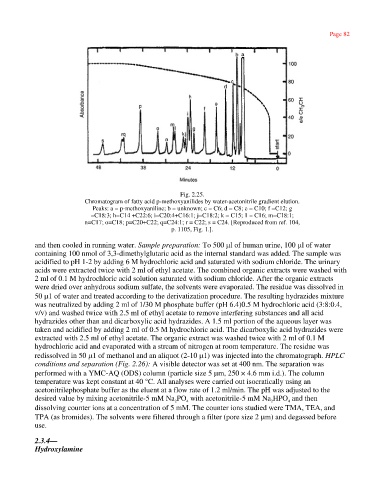
                                                          Fig. 2.25.
                            Chromatogram of fatty acid p-methoxyanilides by water-acetonitrile gradient elution.
                              Peaks: a = p-methoxyaniline; b = unknown; c = C6; d = C8; e = C10; f =C12; g
                              =C18:3; h=C14 +C22:6; i=C20:4+C16:1; j=C18:2; k = C15; 1 = C16; m=C18:1;
                            n=C17; o=C18; p=C20+C22; q=C24:1; r = C22; s = C24. [Reproduced from ref. 104,
                                                        p. 1105, Fig. 1.].

            and then cooled in running water. Sample preparation: To 500 µl of human urine, 100 µl of water
            containing 100 nmol of 3,3-dimethylglutaric acid as the internal standard was added. The sample was
            acidified to pH 1-2 by adding 6 M hydrochloric acid and saturated with sodium chloride. The urinary
            acids were extracted twice with 2 ml of ethyl acetate. The combined organic extracts were washed with
            2 ml of 0.1 M hydrochloric acid solution saturated with sodium chloride. After the organic extracts
            were dried over anhydrous sodium sulfate, the solvents were evaporated. The residue was dissolved in
            50 µ1 of water and treated according to the derivatization procedure. The resulting hydrazides mixture
            was neutralized by adding 2 ml of 1/30 M phosphate buffer (pH 6.4)0.5 M hydrochloric acid (3:8:0.4,
            v/v) and washed twice with 2.5 ml of ethyl acetate to remove interfering substances and all acid
            hydrazides other than and dicarboxylic acid hydrazides. A 1.5 ml portion of the aqueous layer was
            taken and acidified by adding 2 ml of 0.5 M hydrochloric acid. The dicarboxylic acid hydrazides were
            extracted with 2.5 ml of ethyl acetate. The organic extract was washed twice with 2 ml of 0.1 M
            hydrochloric acid and evaporated with a stream of nitrogen at room temperature. The residue was
            redissolved in 50 µ1 of methanol and an aliquot (2-10 µ1) was injected into the chromatograph. HPLC
            conditions and separation (Fig. 2.26): A visible detector was set at 400 nm. The separation was
            performed with a YMC-AQ (ODS) column (particle size 5 µm, 250 × 4.6 mm i.d.). The column
            temperature was kept constant at 40 °C. All analyses were carried out isocratically using an
            acetonitrilephosphate buffer as the eluent at a flow rate of 1.2 ml/min. The pH was adjusted to the
            desired value by mixing acetonitrile-5 mM Na PO  with acetonitrile-5 mM Na HPO  and then
                                                         2  4                          2     4
            dissolving counter ions at a concentration of 5 mM. The counter ions studied were TMA, TEA, and
            TPA (as bromides). The solvents were filtered through a filter (pore size 2 µm) and degassed before
            use.

            2.3.4—
            Hydroxylamine


            http://emedia.netlibrary.com/nlreader/nlreader.dll?bookid=17968&filename=Page_82.html     30/09/2003

