


Page 252 - Modern Derivatization Methods for Separation Sciences
P. 252
Document                                                                                Página 1 de 2


                                                                                                         Page 117


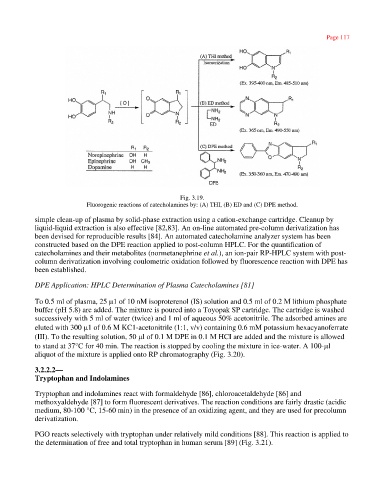
                                                          Fig. 3.19.
                             Fluorogenic reactions of catecholamines by: (A) THI, (B) ED and (C) DPE method.

            simple clean-up of plasma by solid-phase extraction using a cation-exchange cartridge. Cleanup by
            liquid-liquid extraction is also effective [82,83]. An on-line automated pre-column derivatization has
            been devised for reproducible results [84]. An automated catecholamine analyzer system has been
            constructed based on the DPE reaction applied to post-column HPLC. For the quantification of
            catecholamines and their metabolites (normetanephrine et al.), an ion-pair RP-HPLC system with post-
            column derivatization involving coulometric oxidation followed by fluorescence reaction with DPE has
            been established.

            DPE Application: HPLC Determination of Plasma Catecholamines [81]

            To 0.5 ml of plasma, 25 µ1 of 10 nM isoproterenol (IS) solution and 0.5 ml of 0.2 M lithium phosphate
            buffer (pH 5.8) are added. The mixture is poured into a Toyopak SP cartridge. The cartridge is washed
            successively with 5 ml of water (twice) and 1 ml of aqueous 50% acetonitrile. The adsorbed amines are
            eluted with 300 µ1 of 0.6 M KC1-acetonitrile (1:1, v/v) containing 0.6 mM potassium hexacyanoferrate
            (III). To the resulting solution, 50 µl of 0.1 M DPE in 0.1 M HCI are added and the mixture is allowed
            to stand at 37°C for 40 min. The reaction is stopped by cooling the mixture in ice-water. A 100-µl
            aliquot of the mixture is applied onto RP chromatography (Fig. 3.20).

            3.2.2.2—
            Tryptophan and Indolamines

            Tryptophan and indolamines react with formaldehyde [86], chloroacetaldehyde [86] and
            methoxyaldehyde [87] to form fluorescent derivatives. The reaction conditions are fairly drastic (acidic
            medium, 80-100 °C, 15-60 min) in the presence of an oxidizing agent, and they are used for precolumn
            derivatization.

            PGO reacts selectively with tryptophan under relatively mild conditions [88]. This reaction is applied to
            the determination of free and total tryptophan in human serum [89] (Fig. 3.21).


            http://emedia.netlibrary.com/nlreader/nlreader.dll?bookid=17968&filename=Page_117.ht...   30/09/2003

