


Page 261 - Modern Derivatization Methods for Separation Sciences
P. 261
Document                                                                                Página 1 de 2


                                                                                                         Page 122


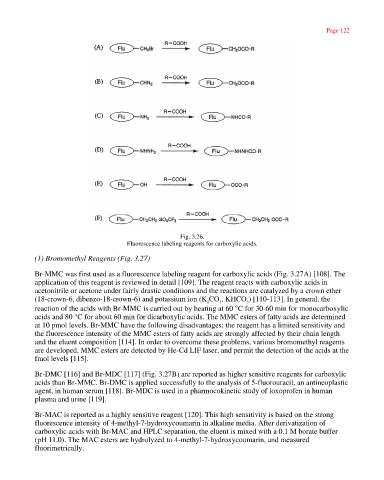
                                                          Fig. 3.26.
                                         Fluorescence labeling reagents for carboxylic acids.
            (1) Bromomethyl Reagents (Fig. 3.27)


            Br-MMC was first used as a fluorescence labeling reagent for carboxylic acids (Fig. 3.27A) [108]. The
            application of this reagent is reviewed in detail [109]. The reagent reacts with carboxylic acids in
            acetonitrile or acetone under fairly drastic conditions and the reactions are catalyzed by a crown ether
            (18-crown-6, dibenzo-18-crown-6) and potassium ion (K CO , KHCO ) [110-113]. In general, the
                                                                   2
                                                                       3
                                                                               3
            reaction of the acids with Br-MMC is carried out by heating at 60 °C for 30-60 min for monocarboxylic
            acids and 80 °C for about 60 min for dicarboxylic acids. The MMC esters of fatty acids are determined
            at 10 pmol levels. Br-MMC have the following disadvantages; the reagent has a limited sensitivity and
            the fluorescence intensity of the MMC esters of fatty acids are strongly affected by their chain length
            and the eluent composition [114]. In order to overcome these problems, various bromomethyl reagents
            are developed. MMC esters are detected by He-Cd LIF laser, and permit the detection of the acids at the
            fmol levels [115].

            Br-DMC [116] and Br-MDC [117] (Fig. 3.27B) are reported as higher sensitive reagents for carboxylic
            acids than Br-MMC. Br-DMC is applied successfully to the analysis of 5-fluorouracil, an antineoplastic
            agent, in human serum [118]. Br-MDC is used in a pharmocokinetic study of loxoprofen in human
            plasma and urine [119].


            Br-MAC is reported as a highly sensitive reagent [120]. This high sensitivity is based on the strong
            fluorescence intensity of 4-methyl-7-hydroxycoumarin in alkaline media. After derivatization of
            carboxylic acids with Br-MAC and HPLC separation, the eluent is mixed with a 0.1 M borate buffer
            (pH 11.0). The MAC esters are hydrolyzed to 4-methyl-7-hydroxycoumarin, and measured
            fluorimetrically.


            http://emedia.netlibrary.com/nlreader/nlreader.dll?bookid=17968&filename=Page_122.ht...   30/09/2003

